Late Bloomer review: a sunshine artist, a guarded flower farmer and a disputed home
After a lottery win exposes how readily other people use her generosity, Opal Devlin spends most of the money on an Asheville flower farm where she hopes to paint. Pepper Boden already lives and works there and believes the property belongs to her, so a disputed purchase puts an impulsive, socially open artist in the home of a wary farmer who prizes continuity and control.
This researched assessment recommends Late Bloomer when the contrast you want is sunshine-versus-guarded behavior grounded in work, housing and neurodivergent communication. The low-stakes pastoral mood does not erase the property conflict or exploitative family relationships, and selected dissent finds the chemistry quieter than the individual characterization.
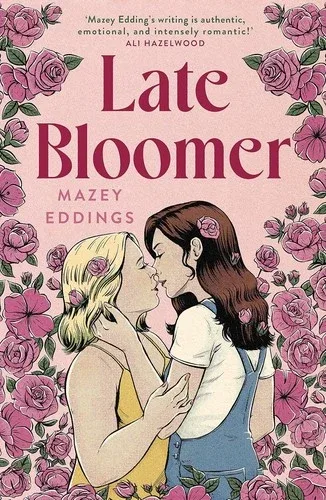
Authentic published cover for Mazey Eddings’s Late Bloomer; exact edition scope is stated in the facts table.
The verdict
A tender sapphic opposites romance whose flower-farm labor and neurodivergent communication give the contrast substance, though the gentle pace and family resolution will not persuade every reader.
★★★★★★★★★★Provisional Eikna score: 3.9/5. Four core dimensions cover 85% of the quality weight. Ending satisfaction and reread appeal remain unscored; heat is excluded. Researched editorial assessment; no firsthand reading claimed. Evidence confidence: moderate.
Spice, ending and series
Is Late Bloomer spicy?
A numeric heat level has not been established. Read the review’s heat and content discussion for attributed descriptions before choosing. An unknown level is not a closed-door or no-spice promise.
The romantic outcome is not established in this summary. A romance label does not independently confirm an ending. Consult the discussion before choosing if closure is essential.
For the difference between romantic commitment and wider plot closure, compare HEA, HFN and cliffhangers.
Can I read it on its own?
Standalone or continuing-series status is not established in this summary. Read the existing format and series guidance for any available context; do not assume a missing series entry means the book stands alone.
The series-order guide explains what to check when a complete romance belongs to a connected world.
Book and edition facts
Identity facts and explicit research limits
Title
Late Bloomer
Author
Mazey Eddings
Inspected edition
US St. Martin's Griffin paperback · ISBN 9781250847089 · 400 pages
Publication scope
Published 2024-04-16 · checked 12 October 2026
ISBN-13
9781250847089
Edition page count
400 pages
The author or publisher evidence identifies the work. Publication dates refer to the stated edition or release scope, not automatically the first appearance of the story. Unknown identifiers and formats are left open.
Spoiler-free premise
Macmillan makes Opal's lottery purchase and Pepper's existing claim to the farm the concrete reason they cannot simply avoid one another.
The arrangement creates both attraction and an ethical problem: the home and business matter independently of whether the pair becomes compatible.
What makes them opposites
Opal is impulsive, expressive and quick to trust; Pepper is protective, structured and suspicious of change after years of responsibility.
Their difference is not reduced to optimism versus pessimism. Art, farming, money and approaches to community repeatedly turn temperament into practical choices.
Neurodivergence and communication
Kirkus and The Lesbrary both discuss neurodivergent characterization as part of how the leads misunderstand and eventually accommodate each other.
The assessment does not diagnose beyond the source material or treat neurodivergence as the cause of every conflict.
Where the softness divides
Supportive criticism finds the farm, queer friendships and care work comforting rather than empty.
Selected dissent does not feel sufficient chemistry, and Kirkus questions parts of the family resolution. Readers who need sustained external pressure may find the gentleness underpowered.
Heat and content notes
The publisher markets the book as sexy and firsthand critics report on-page intimacy. No numeric heat, exact scene count or complete timing audit is asserted. Kirkus Reviews. The Lesbrary.
Exploitative family and friends, property dispute, housing insecurity, grief, emotional manipulation, neurodivergent stress and explicit sex appear in inspected material. Notes are attributed and non-exhaustive. Kirkus Reviews. The Lesbrary. Selected Goodreads reader testimony.
Who should consider it
Best for readers who want queer community, forced cohabitation, an artist/farmer work contrast and a soft rural atmosphere. Avoid if disputed housing, exploitative relatives, low external tension or chemistry built through domestic care rather than sharp banter are poor fits.
What the contrasting responses mean
Supportive critics value queer joy, the farm setting and specific neurodivergent communication. The main reservations concern muted chemistry, low tension and family conflicts resolved more neatly than some readers expect.
Purchases through Amazon, Bookshop.org and Libro.fm links may earn us a commission. As an Amazon Associate, Eikna Romance earns from qualifying purchases, at no extra cost to you.
Format, series and purchase guidance
The official publisher material assigns no numbered series position. This record treats the central romance as self-contained without inferring a work-level ending classification.
The inspected Amazon product identity matches the stated title and edition. Confirm the selected format before buying; current price and stock are not established.
AmazonAudibleBookshop.org · edition not verifiedLibro.fm · edition not verified
Disabled actions mean the exact destination has not been verified, not that a format is unavailable. Confirm the selected edition and format before purchasing.
Seven-dimension evidence scorecard
Quality scale: 1 substantial weaknesses; 2 weaknesses outweigh strengths; 3 mixed; 4 strengths outweigh limitations; 5 exceptional sustained strengths. Half points are allowed. Weights: romance 30%, characters 20%, writing 20%, emotional impact 15%, ending satisfaction 10%, reread appeal 5%. A provisional overall score divides the supported weighted sum by its supported weight and rounds once to one decimal. Heat is descriptive and excluded. These scores express the evidence-based judgment explained in this review.
No inspected source verifies a completed reread. Kirkus Reviews
Questions before choosing
What is the central relationship setup?
After a lottery win exposes how readily other people use her generosity, Opal Devlin spends most of the money on an Asheville flower farm where she hopes to paint. Pepper Boden already lives and works there and believes the property belongs to her, so a disputed purchase puts an impulsive, socially open artist in the home of a wary farmer who prizes continuity and control.
Is it a standalone?
The inspected publisher material presents a self-contained central romance and assigns no numbered series position. Eikna does not infer a broader shared-world guarantee.
Is the romance explicit?
Firsthand critics report on-page sexual content. Eikna does not infer a numeric heat level, scene frequency or timing from another site’s scale.
Which edition was checked?
The facts table uses the US St. Martin's Griffin paperback, ISBN 9781250847089, with 400 pages.
Does the review reveal the ending?
No work-level ending classification is asserted. Ending satisfaction and reread appeal remain unscored.
Why is the score provisional?
Only the four core quality dimensions are supported. Heat is descriptive and excluded; ending satisfaction and reread appeal remain unknown.
For a different cohabitation structure built on learning an apparently incompatible daily rhythm.
Follow the discovery route
The contemporary romance collection includes this book among other choices. Compare those options if its premise appeals but a limitation gives you pause. The Opposites-attract romance books explains the surrounding reading route and what to check before choosing.
Final recommendation
A tender sapphic opposites romance whose flower-farm labor and neurodivergent communication give the contrast substance, though the gentle pace and family resolution will not persuade every reader. Best for readers who want queer community, forced cohabitation, an artist/farmer work contrast and a soft rural atmosphere. Avoid if disputed housing, exploitative relatives, low external tension or chemistry built through domestic care rather than sharp banter are poor fits.
Macmillan official Late Bloomer page. Inspected for this assessment; source URLs and lineage are retained in the local evidence record.
Macmillan exact print edition record. Inspected for this assessment; source URLs and lineage are retained in the local evidence record.
Kirkus Reviews. Inspected for this assessment; source URLs and lineage are retained in the local evidence record.
The Lesbrary. Inspected for this assessment; source URLs and lineage are retained in the local evidence record.
Selected Goodreads reader testimony. Inspected for this assessment; source URLs and lineage are retained in the local evidence record.
Checked 2026-10-12. The How this assessment was researched preserves attributions and research limits. Unknown details do not establish absence. Purchasing links use our account.