The American Roommate Experiment by Elena Armas Review
Eikna Score: 6.9/10. Recommended with reservations.
The American Roommate Experiment is a sweet, overlong roommates romance in which a blocked romance writer and her best friend's charming Spanish cousin share a tiny New York studio and test her dating theories on each other. Lucas is easy to fall for and the book is warm, but with no real obstacle between the leads, the slow burn mostly stalls.
Read it if you loved The Spanish Love Deception, or want a soft, caretaking hero in a forced proximity setup. Skip it if you need genuine conflict to keep a 400-page book moving, or found Armas's first book too long.
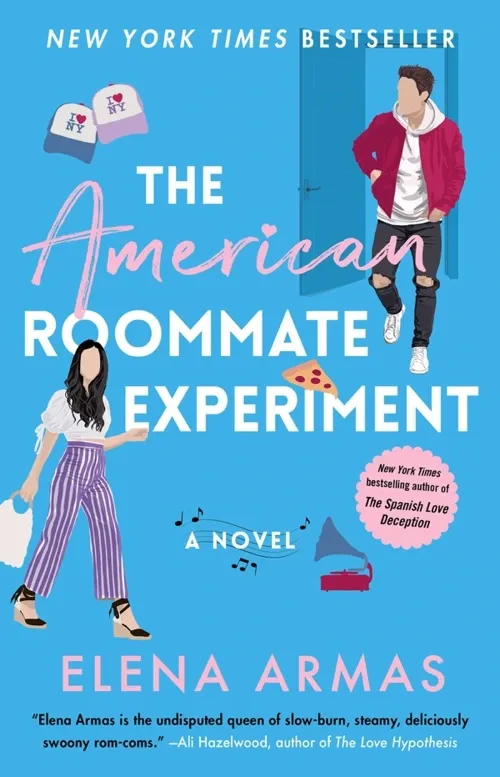
The American Roommate Experiment at a Glance
The American Roommate Experiment is Elena Armas's 2022 contemporary romance and book 2 of the Love Deception series, published by Atria Books on September 6, 2022. It follows Rosie Graham and Lucas Martín, forced into a shared New York studio, across 400 pages in alternating viewpoints, and ends with a happily ever after.
| Author | Elena Armas |
|---|---|
| Series | Love Deception, book 2 (new couple; works as a standalone) |
| Subgenre | Contemporary romance (New York City) |
| Main tropes | Forced proximity, roommates, slow burn, practice dates, best friend's cousin |
| Spice level | 3/5: Moderate, some open door |
| Content warnings | Career-ending injury, career uncertainty, family worries (full list below) |
| POV | Dual, alternating between Rosie and Lucas |
| Ending | HEA |
| Pages | 400 (paperback) |
| Audiobook | Narrated by Jennifer Jill Araya and Noah B. Perez, 14 hours 45 minutes (Simon & Schuster Audio) |
| First published | September 6, 2022 |
| Publisher | Atria Books (Simon & Schuster) |
What Is The American Roommate Experiment About?
The American Roommate Experiment follows Rosie Graham, who has quit her steady job to write romance and promptly lost the ability to write a word. Then the ceiling of her apartment comes down, and her best friend Lina offers her small New York studio, which should be empty.
It is not empty. Lina's cousin Lucas, visiting from Spain for a few weeks, is already staying there, and Rosie has quietly followed him online for a while. Lucas offers to share. When he learns about her writer's block, he proposes an experiment: a series of dates, planned like research, to get her stories moving again. Neither of them is supposed to take the dates seriously.
What Makes This Forced Proximity Romance Work
The American Roommate Experiment works on readers because of Lucas. He cooks, he notices things, he is endlessly patient with Rosie's spirals, and he is gorgeous in a way the book is not shy about. Harlequin Junkie admired how compassionate he is, and that is the core of the appeal: a kind hero in a very small apartment.
The second hook is the self-awareness. Culturefly reviewer Megan Davies called the book a love letter to romance fiction, and the experimental dates let Armas play with the scenes readers already love, starting with the meet-cute. Rosie is a romance writer who knows the beats, and the book winks at them.
And it comes with built-in readers. The Spanish Love Deception was a BookTok phenomenon, and Rosie and Lina carried over from it. If you read forced proximity romance for the shared-bathroom moments and the slow build, this was one of the most talked-about examples of 2022.
My Review
I wanted to love The American Roommate Experiment more than I did. Lucas is one of the gentlest heroes I have read in a long time, and there are scenes in that cramped studio that made me grin. But the book is 400 pages long and has about 250 pages of story, and the gap is filled with two people who clearly want each other finding reasons not to say so.
Romance and Chemistry
The chemistry is immediate, which is both the pleasure and the problem. Rosie and Lucas are attracted from the first chapters, and the practice dates are full of tension that plainly is not practice. Culturefly felt that tension and called the romance a genuine slow burn with real emotional grounding. I enjoyed several of the dates for the same reason.
But a slow burn needs something holding the couple apart. All About Romance reviewer Jenna Harper, who graded it a C plus, pointed out that there is no real obstacle to their relationship, which makes the experimental dates feel unnecessary, and that the delay comes from manufactured drama and interrupted moments. Kyara Roberson at What Is That Book About made a similar point: both leads are likable, but there is too little believable resistance. I agree. Lucas's planned return to Spain should be the clock, and it rarely feels like one.
The Characters
Lucas is the best thing here. He is a former professional surfer whose career ended with an injury, and he hides real hurt under his easy charm. Harlequin Junkie loved the reciprocal care between two people who are used to looking after everyone else, and that dynamic is where the book is most moving. When Lucas lets Rosie look after him, it lands.
Rosie is harder. She is funny and anxious, but AAR's Jenna Harper found her ditzy and insecure, and felt she reads differently in her own chapters than in Lucas's. That inconsistency bothered me too. Harper also noted that Lucas's view of himself as damaged goods appears when the plot needs it and fades when it does not.
The family thread is the weakest part. Culturefly called the subplot involving Rosie's brother underdeveloped, and Northeastern's Huntington News felt it was a cheap device. It is introduced with weight and resolved in a hurry.
Writing and Pacing
Armas writes warmly and with humor, and the dual viewpoint is a clear improvement on the single narrator of book one. Culturefly valued hearing from both leads, and seeing Lucas fall is the book's best trick. Kirkus, reviewing the audiobook, found the two narrators gave the familiar story a fresh feel.
The length is the real problem. Culturefly questioned the novel's length and found it slow to start. Huntington News suggested it could lose about 100 pages, and I would not argue. The push and pull repeats, scene after scene, without changing much between them.
The ending, without spoiling it, gives both characters the warm resolution readers want. Getting there takes patience.
The American Roommate Experiment has a lovely hero and a sweet, cozy premise, stretched far past what its thin conflict can carry. Read it if you adored The Spanish Love Deception or want a soft hero; otherwise, try a tighter roommates romance first.
How Spicy Is The American Roommate Experiment?
The American Roommate Experiment is a 3 out of 5 on our scale: Moderate, some open door. The tension runs through the whole book, and Culturefly mentioned swoony, steamy scenes once Rosie and Lucas stop holding back. All About Romance rated its sensuality warm by that site's scale.
Romance.io readers rate it higher, at 4 out of 5 for explicit open door content, so expect on-page sex scenes in the later part of the book rather than a fade to black. Consent is clear throughout. Our heat levels guide explains the full scale.
Content warnings, drawn from reader reports and our own read:
- A career-ending sports injury and its aftermath
- A life-changing accident in the hero's past, per Harlequin Junkie
- Imposter syndrome and career uncertainty
- Family worries involving the heroine's younger brother
- Housing damage and displacement
- On-page sexual content
Our content warnings guide explains how we compile these lists.
Who Should Read The American Roommate Experiment?
The American Roommate Experiment suits readers who want a cozy forced proximity romance with a caretaking hero, a romance writer heroine and plenty of flirtation. It suits fewer readers who want real obstacles, tight pacing or a strong subplot.
Best for:
- Fans of The Spanish Love Deception who want more of that world
- Readers who love forced proximity in a small space
- Anyone looking for a kind, attentive hero
- Readers who enjoy romances about romance writers
Not for:
- Readers who need genuine conflict in a slow burn
- Anyone who found Armas's first book too long
- Readers who want a well-developed family subplot
- Anyone wanting closed door romance (try our closed door picks)
What Readers and Critics Are Saying
The American Roommate Experiment divided reviewers more than The Spanish Love Deception did. Almost everyone likes Lucas; the argument is over whether the romance has enough conflict, and whether the book needs 400 pages.
Where they agree. The hero and the warmth. Harlequin Junkie praised the mutual care and compassionate Lucas. Culturefly gave it 4 out of 5 and liked the dual viewpoints and chemistry. Kirkus called the audiobook colorful and sweet.
Where they split. Conflict and length. All About Romance graded it C plus, finding no real obstacle and inconsistent characterization of Rosie. Kyara Roberson at What Is That Book About saw a trope checklist rather than a cohesive romance. Huntington News gave it 3 out of 5, objecting to the length and the insta-love attraction. Even Culturefly found it slow to start and too long.
The Eikna Evidence Scorecard
The American Roommate Experiment scores 6.9 out of 10 on the Eikna Evidence Scorecard, with its best marks for the ending and characters, and lower scores for writing, pacing and reread appeal in a book that runs long.
| Dimension | Score (/5) | Why |
|---|---|---|
| Romance (20%) | 3.5 | Real chemistry per Culturefly, but no real obstacle, per All About Romance. |
| Characters (15%) | 3.5 | Lucas is a standout per Harlequin Junkie; Rosie is inconsistent, per All About Romance. |
| Writing and pacing (15%) | 3 | Warm and funny, but slow to start and overlong, per Culturefly and Huntington News. |
| Emotional impact (15%) | 3.5 | Mutual caretaking moves, per Harlequin Junkie; the family subplot is thin. |
| Heat level (10%) | 3.5 | Delivers moderate, late open door heat; Romance.io readers rate it steamier. |
| Ending satisfaction (15%) | 4 | A warm, satisfying HEA for both leads. |
| Reread appeal (10%) | 3 | The dates are fun to revisit; the full length makes a reread hard. |
The Eikna Overall Ranking: The American Roommate Experiment is the weaker of Elena Armas's two Love Deception books and sits in the middle of the 2022 roommates romance wave, landing at a final Eikna Score of 6.9/10.
Love Deception Series Reading Order
The American Roommate Experiment is book 2 of Elena Armas's Love Deception series, after The Spanish Love Deception. Rosie and Lucas have their own complete story, but Rosie and her best friend Lina appear in book one, so reading in order adds context.
- The Spanish Love Deception (2021; Atria edition 2022): Catalina and Aaron
- The American Roommate Experiment (2022): Rosie and Lucas
Best format: the audiobook, with Jennifer Jill Araya and Noah B. Perez voicing the two viewpoints, which Kirkus praised, and which makes the long middle go faster. Our series order guide covers more connected romances.
If You Loved The American Roommate Experiment, Read These Next
If you loved The American Roommate Experiment, look for forced proximity romances with shared spaces, soft heroes and a lot of banter, starting with the book that came before it.
- The Spanish Love Deception by Elena Armas: the first Love Deception book, a fake date to a family wedding in Spain.
- The Flatshare by Beth O'Leary: two strangers share a London flat and a bed on opposite schedules, falling for each other through notes.
- When in Rome by Sarah Adams: a burned-out pop star hides out in a small town under the roof of a grumpy local.
- The Unhoneymooners by Christina Lauren: two enemies take a free honeymoon together, with sharper comedy and more conflict.
Frequently Asked Questions
The American Roommate Experiment raises the same questions from most readers: how spicy it is, whether you need the first book, how it ends and who narrates it. Short answers below.
Is The American Roommate Experiment spicy?
Moderately. It is a 3 out of 5 on our scale, with on-page sex scenes later in the book after a long build.
Do I need to read The Spanish Love Deception first?
No. The American Roommate Experiment follows a new couple and stands alone, though Rosie and Lina first appear in The Spanish Love Deception.
Does The American Roommate Experiment have a happy ending?
Yes. The American Roommate Experiment ends with a happily ever after for Rosie and Lucas.
Who is Lucas in The American Roommate Experiment?
Lucas Martín is the Spanish cousin of Rosie's best friend Lina, a former professional surfer whose career ended with an injury.
Who narrates The American Roommate Experiment audiobook?
Jennifer Jill Araya and Noah B. Perez narrate the Simon & Schuster Audio edition, which runs 14 hours 45 minutes.
Where is The American Roommate Experiment set?
The American Roommate Experiment is set in New York City, mostly in Lina's small studio apartment.
The Bottom Line
The American Roommate Experiment earns a 6.9/10 and a Recommended with reservations badge. It is for readers who loved The Spanish Love Deception, or who want a cozy forced proximity romance with a tender, attentive hero and do not mind a long, low-conflict build. The reason to pick it up is Lucas, who makes a slow book worth sticking with.
Buy on Amazon Buy at Bookshop.org Listen on Audible Listen on Libro.fm
Some links on this page are affiliate links: Eikna Romance may earn a small commission at no extra cost to you.
Sources
- The American Roommate Experiment, Atria Books (edition facts, series, premise)
- The American Roommate Experiment audiobook, Kirkus Reviews
- The American Roommate Experiment audiobook, Libro.fm
- The American Roommate Experiment audiobook, Audible
- The American Roommate Experiment, All About Romance (Jenna Harper)
- Book review: The American Roommate Experiment, Culturefly (Megan Davies)
- Review: The American Roommate Experiment yields mixed results, Huntington News (Cynthia Chen)
- The American Roommate Experiment, Romance.io
- Harlequin Junkie and What Is That Book About (Kyara Roberson) reviews
How we review: every Eikna score is built from a seven-part evidence scorecard. Read our methodology.