The Co-op by Tarah DeWitt Review
Eikna Score: 7.7/10. Recommended.
The Co-op is a second chance marriage of convenience romance in which two former teenage flames renovate a crumbling building with no interior walls, and Tarah DeWitt makes the renovation do real emotional work. It is warm, funny and quietly sad about family, though the old hurt between LaRynn and Deacon gets less airtime than it deserves.
Read it if you like second chances with dual timelines, renovation plots and grief handled with a light touch. Skip it if you need every old wound talked through on the page, or you want a big friend group around the couple.
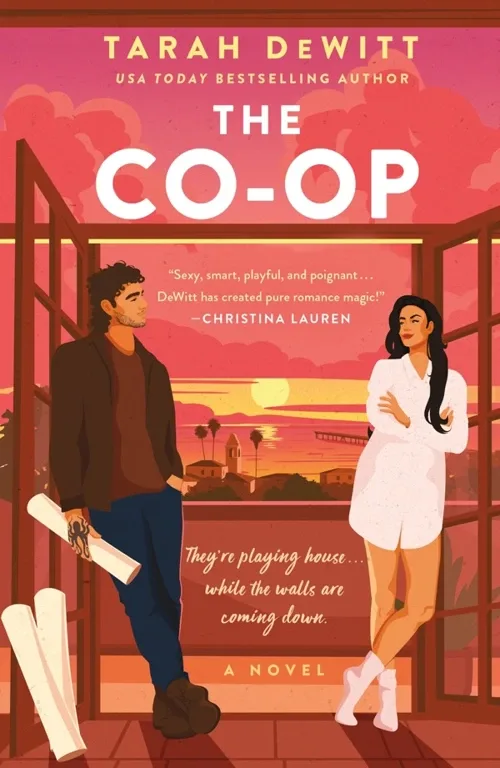
The Co-op at a Glance
The Co-op is a standalone contemporary romance by Tarah DeWitt, published by St. Martin's Griffin on November 12, 2024. LaRynn Lavigne and Deacon Leeds inherit a run-down building from their grandmothers and marry so she can unlock the money to fix it. It has moderate heat, dual timelines and a happy ending.
| Author | Tarah DeWitt |
|---|---|
| Series | Standalone |
| Subgenre | Contemporary romance |
| Main tropes | Second chance, marriage of convenience, forced proximity, slow burn, renovation romance |
| Spice level | 3/5: Moderate, some open door |
| Content warnings | Death of grandparents, grief, estranged and harmful parents, abandonment, death of a parent (full list below) |
| POV | Alternating LaRynn and Deacon, across past and present timelines |
| Ending | HEA |
| Pages | 352 (trade paperback) |
| Audiobook | Narrated by Amy Hall and Tim Paige, about 10 hours 26 minutes (Tantor Audio) |
| First published | November 12, 2024 (St. Martin's Griffin edition) |
| Publisher | St. Martin's Griffin |
What Is The Co-op About?
The Co-op begins with an inheritance. LaRynn Lavigne and Deacon Leeds once had a brief, combative summer fling as teenagers. Years later, their two grandmothers leave them a dilapidated building in Santa Cruz, jointly.
LaRynn has money but cannot touch her trust fund unless she is married. Deacon has the construction skills but not the cash. So they make a deal: marry, renovate, sell, split the profits and go their separate ways. The catch is the building itself. They have to live in it while they work, and the home has no interior walls, which means nowhere to hide from each other or from what went wrong between them.
What Makes This Second Chance Romance Work
The Co-op works as a second chance romance because it gives the past a physical address. LaRynn and Deacon are not just reconnecting; they are tearing out and rebuilding the place their grandmothers left them, and every room they finish is a decision about what to keep. Publishers Weekly called the renovation an effective metaphor, and it is.
The open-plan living is the second hook. It turns a marriage of convenience into strict forced proximity: no doors, no private corners, nothing to slam. Kirkus noted that the book is more about rekindling an old love than meeting someone new, and the dual timeline lets you watch the teenage version and the adult version side by side. Publishers Weekly praised DeWitt for handling tough issues "without ever losing sight of the fun," and that balance is the pitch. If you liked the banter and grief of DeWitt's Funny Feelings, this is a steadier, more grown-up version of the same instincts.
My Review
The Co-op is the kind of romance where the house matters as much as the couple. Tarah DeWitt builds the book out of plaster dust, arguments over fixtures and two adults who keep catching each other in a space with no walls, and the result is warm, funny and sadder than its premise suggests. I liked it a lot, with one real reservation.
Reception has been strong. Kirkus called it "a swoony slow-burn romance that lives in the little moments," and Publishers Weekly said it satisfies. Phoebe Wright at Read & Wright gave it five out of five and found nothing that did not work. Harlequin Junkie found both leads flawed and the second chance heartfelt and mature. The dissent comes from readers like danchuchie on StoryGraph, who felt the decade-old rupture was never properly discussed. I think that is the right criticism.
Romance and Chemistry
The chemistry is slow and specific. DeWitt is good at small moments, as Kirkus noticed: glances, jokes and acts of care that do more than speeches. The forced intimacy of the open floor plan builds tension without any contrivance beyond the premise, and the fake marriage adds a legal edge, since both of them know exactly when the arrangement is meant to end.
My reservation is the past. The teenage fling ended badly, and the book shows us enough to know it mattered. But when it comes time to deal with it, the conversation is shorter than the hurt. danchuchie on StoryGraph felt the reconciliation was incomplete for that reason, and I mostly agree. The romance is earned through present-day work more than through reckoning with what happened, which is satisfying, but a little evasive.
The Characters
LaRynn is reserved in a way romance heroines often are not, and Harlequin Junkie praised that restraint. She has money and very little family warmth behind it, and her guardedness reads as earned. Deacon opens up gradually, which Harlequin Junkie also singled out, and he is a convincing mix of competence, pride and soft spots. Both are flawed in ways that cause real friction.
The grandmothers are present in absence, and they are lovely. The parents are another matter: one critic pointed to harmful parenting and old emotional wounds, and Read & Wright listed estrangement, abandonment and the death of a parent in its content notes. The supporting friendships are thinner. Anchored Musings enjoyed the humor, the music and the character growth but wanted more friendship scenes, and I would have liked a few more people in the building too.
Writing and Pacing
DeWitt's prose is easy to read and often funny, and Read & Wright found it beautiful and emotionally strong. The alternating points of view and the dual timeline are handled cleanly. The past sections give context for the present without taking over the book.
The pacing is deliberately unhurried. The renovation sets the rhythm, so the middle of the book is a run of jobs, setbacks and small victories. I enjoyed that, but readers who want a big plot will find it quiet. The ending, Kirkus said, is a hard-earned path to happily ever after, and it does feel worked for.
The Co-op is a tender, funny second chance romance where the renovation carries the emotion. Read it if you like slow, domestic intimacy; skip it if you need the old hurt fully aired.
How Spicy Is The Co-op?
The Co-op is a 3 out of 5 on our scale: Moderate, some open door. Phoebe Wright at Read & Wright rated the spice three out of five, and the publisher's description calls the romance steamy. Kirkus calls it a slow burn, so the heat builds gradually, and the intimate scenes are consensual and sit inside the emotional arc rather than driving it.
For more in this range, see our spicy romance list, and the romance heat levels guide explains the scale.
Content warnings, drawn from the publisher and reviewers:
- Death of both leads' grandmothers before the story begins, and grief
- Estranged relationships with parents and harmful parenting
- Abandonment
- Death of a parent
- Old emotional wounds from a teenage relationship
- Moderate on-page sexual content
Our content warnings guide explains how we compile these lists.
Who Should Read The Co-op?
The Co-op suits readers who want a warm, grown-up second chance romance with a marriage of convenience, a renovation project and grief handled lightly. It is less suited to readers who want fast pacing, a big ensemble or a full on-page reckoning with the past.
Best for:
- Fans of second chance romance with dual timelines
- Readers who love renovation and house-flip stories
- Anyone who likes marriage of convenience with real stakes
- Readers who enjoy reserved heroines and slow-opening heroes
- Fans of Tarah DeWitt's Funny Feelings
Not for:
- Readers who need the old breakup fully discussed
- Anyone looking for a busy friend group
- Readers who want high spice
- People who dislike slow, domestic pacing
What Readers and Critics Are Saying
The Co-op has a warm reception from trade reviewers and bloggers, with most praise for the emotional maturity and the renovation metaphor and most criticism for how the past is resolved.
Where they agree. The emotional craft. Kirkus praised the slow burn and the little moments, Publishers Weekly called it sensitive and fun at once, Harlequin Junkie found the second chance heartfelt and mature, and Read & Wright loved the prose and the leads. Anchored Musings enjoyed the humor and the character growth.
Where they split. The past and the people around the couple. danchuchie on StoryGraph felt the original rupture was never adequately discussed, so the reconciliation felt incomplete, while trade reviewers found the path to the ending well earned. Anchored Musings wanted more friendship scenes. Neither complaint stops most readers from recommending it.
The Eikna Evidence Scorecard
The Co-op scores 7.7 out of 10 on the Eikna Evidence Scorecard. Its strongest marks go to the romance, characters, writing and emotional impact, and its lowest to heat, ending and reread appeal, where the unexamined past keeps it from the top tier.
| Dimension | Score (/5) | Why |
|---|---|---|
| Romance (20%) | 4 | Kirkus praises the swoony little moments; the old hurt is underexplored. |
| Characters (15%) | 4 | Harlequin Junkie likes LaRynn's reserve and Deacon's slow opening up. |
| Writing and pacing (15%) | 4 | Read & Wright praises the prose; dual timelines are handled cleanly. |
| Emotional impact (15%) | 4 | Grief and family weight, handled with fun intact, per Publishers Weekly. |
| Heat level (10%) | 3.5 | Moderate heat that suits the slow build, per Read & Wright's 3/5. |
| Ending satisfaction (15%) | 3.5 | A hard-earned HEA per Kirkus; danchuchie finds reconciliation incomplete. |
| Reread appeal (10%) | 3.5 | The renovation and small moments reward a second read. |
The Eikna Overall Ranking: The Co-op is a mature, rewarding second chance romance that sits just behind Tarah DeWitt's Funny Feelings among her books we have reviewed, with a final Eikna Score of 7.7/10.
Is The Co-op a Standalone?
Yes. The Co-op is a standalone romance with no series ties, so you can start here with no prior reading. It is a good entry point to Tarah DeWitt, whose other contemporary romances include Funny Feelings.
Best format: the Tantor audiobook uses two narrators, Amy Hall and Tim Paige, which suits the alternating points of view. Print and ebook editions come from St. Martin's Griffin in the US and Piatkus in the UK. Our HEA and HFN guide explains how we classify endings.
If You Loved The Co-op, Read These Next
If you loved The Co-op, try these romances about rebuilding, old flames and arrangements that become real.
- Funny Feelings by Tarah DeWitt: a stand-up comedian fake dating her manager and best friend, with the same mix of humor and feeling.
- Next to You by Hannah Bonam-Young: a grown-up, tender romance about building a life with someone.
- With You Forever by Chloe Liese: close quarters, slow trust and a deeply emotional slow burn.
- In a Jam by Kate Canterbary: family responsibility, a practical arrangement and plenty of banter.
- The Unhoneymooners by Christina Lauren: a fake marriage, forced togetherness and lighter comedy.
Frequently Asked Questions
The Co-op prompts questions about heat, whether it is a standalone, the ending, the setting and the audiobook.
Is The Co-op spicy?
Moderately. The Co-op is a 3 out of 5 on our scale, with a slow build and some open-door scenes.
Is The Co-op a standalone?
Yes. The Co-op is a standalone romance and does not require any other Tarah DeWitt books.
Does The Co-op have a happy ending?
Yes. LaRynn and Deacon get a hard-won happily ever after.
Where is The Co-op set?
The Co-op is set in Santa Cruz, California, in the run-down building the leads inherit from their grandmothers.
Is there an audiobook of The Co-op?
Yes. The Tantor Audio edition is narrated by Amy Hall and Tim Paige and runs about 10 hours 26 minutes.
What tropes are in The Co-op?
Second chance, marriage of convenience, forced proximity, slow burn and a renovation plot, told in dual timelines.
The Bottom Line
The Co-op earns a 7.7/10 and a Recommended badge. It is for readers who want a warm, slow second chance romance with a marriage of convenience and a house to rebuild, and who can live with an old wound that heals without much talk. The one reason to pick it up is the renovation: Tarah DeWitt makes every wall that goes back up feel like a step toward each other.
Buy on Amazon Buy at Bookshop.org Listen on Audible Listen on Libro.fm
Some links on this page are affiliate links: Eikna Romance may earn a small commission at no extra cost to you.
Sources
- The Co-op, Bookshop.org (edition and publisher description)
- The Co-op, Kirkus Reviews
- The Co-op, Publishers Weekly review
- The Co-op review, Read & Wright (Phoebe Wright)
- The Co-op audiobook, Blackstone Library (narrators and length)
- The Co-op, Google Play (publisher description)
- The Co-op, Hachette UK (Piatkus edition)
- Harlequin Junkie, Anchored Musings and StoryGraph reader danchuchie
How we review: every Eikna score is built from a seven-part evidence scorecard. Read our methodology.