Mr. Impossible by Loretta Chase Review
Eikna Score: 8.5/10. Highly recommended.
Mr. Impossible is Loretta Chase having the time of her life: a Regency caper up the Nile with a brilliant, prickly widow and a handsome troublemaker who turns out to be the best partner she could ask for. Rupert's early pursuit and the colonial-era framing have aged unevenly, but the banter and the partnership carry it.
Read it if you want a romance that is mostly a treasure hunt, or a hero who is openly delighted by a clever woman. Skip it if a hero who keeps pushing after a no is a hard stop for you, or you want Egypt seen through Egyptian eyes.
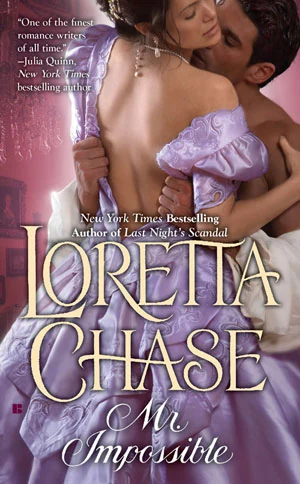
Mr. Impossible at a Glance
Mr. Impossible is Loretta Chase's 2005 Regency adventure romance and book 2 of her Carsington Brothers series, published by Berkley Sensation. It sends a scholar widow and a rogue up the Nile after her kidnapped brother, won the 2006 Barclay Gold Award for historical romance, was a RITA finalist and ends happily ever after.
| Author | Loretta Chase |
|---|---|
| Series | Carsington Brothers, book 2 (a new couple; reads as a standalone) |
| Subgenre | Historical romance (Regency era, Cairo and the Nile) |
| Main tropes | Opposites attract, brains and brawn partnership, adventure quest, widowed heroine, rogue hero |
| Spice level | 3/5: Moderate, some open door |
| Content warnings | Kidnapping, violence, pursuit after refusal, colonial-era framing (full list below) |
| POV | Third person, alternating Daphne and Rupert |
| Ending | HEA |
| Pages | 320 (Berkley Sensation paperback) |
| Audiobook | Narrated by Kate Reading, about 11 hours 48 minutes |
| First published | March 2005 |
| Publisher | Berkley Sensation |
What Is Mr. Impossible About?
Mr. Impossible opens in Cairo, where Daphne Pembroke, a widow with a gift for ancient languages, is working quietly on the hieroglyph puzzle that has obsessed European scholars. Her brother Miles is snatched by men who want what she knows.
The only help on hand is Rupert Carsington, a nobleman's younger son with a gift for trouble, who has just landed in a Cairo jail. Daphne buys him out, and the two head up the Nile after Miles, a missing papyrus and a set of rivals who play rough.
What Makes This Brains and Brawn Romance Work
Mr. Impossible works because neither lead is the joke. Daphne is the expert, Rupert is the muscle, and the book quietly lets each discover the other is more than that. He is not stupid; he simply never saw the point of being clever in public. She is not cold; she was married to a man who made her feel her mind was unwomanly.
The second hook is the setting. A river journey with tombs, desert, hostile rivals and a mongoose in the supporting cast gives the romance an engine that most Regency ballroom plots never have. Historical Novel Society singled out the Nile and desert travel as absorbing, and readers who rate this book highly tend to talk about the trip as much as the couple.
And it is Chase, which means the sentences are funny. If you liked the sparring in Lord of Scoundrels, this is the same instinct moved outdoors and given a plot that keeps moving.
My Review
I started Mr. Impossible expecting a lightweight romp and finished it convinced it is one of Chase's best-built books. It is light, yes. It is also tightly plotted, generous to both leads and very funny. It has a problem in its first third that I will come to, and a setting that a 2005 book handles with mixed success. Neither stopped me from grinning through most of it.
Romance and Chemistry
The chemistry here is admiration first. Rupert is attracted to Daphne before he understands her, but what turns him is watching her work: she reads a stone the way he reads a fight. Daphne, for her part, keeps waiting for him to be the oaf his reputation promises, and he keeps declining to oblige. Historical Novel Society called the relationship a delight to watch unfold, and that is the right word.
What I liked most is that the partnership is real. Rupert does the fighting, but the plot turns on Daphne's scholarship, and he never resents it. A Cannonball Read reviewer put it well: this is a romance about two people backing each other, not one person managing the other.
The same reviewer flagged the weak spot, and I agree. In the early chapters Rupert kisses and gropes Daphne when she has not invited it, and treats her refusals as a game. He changes once he understands her, and the book clearly wants us to see that change, but readers who need consent clean from page one will wince.
The Characters
Daphne is the reason to read this book. She is short-tempered, near-sighted, embarrassed by her own brilliance and still bruised by a husband who disapproved of everything she was. Her arc is learning that her mind is not a defect, and Chase lets her get there through her work rather than through a speech.
Rupert is the best kind of Chase hero: big, cheerful, unbothered and secretly perceptive. He sees through Daphne's brother, through their enemies and eventually through Daphne's own doubts. The supporting cast is lively too, especially Miles, who has his own talent for survival, and the book's Egyptian characters, whom the Cannonball Read reviewer found distinct and alive even in small parts.
That is also where the book shows its age. The story is still told from inside a European treasure hunt, with Egypt as the backdrop for English adventure, and StoryGraph and Reddit readers have objected to its colonial framing and some of its portrayals of Egyptian and Muslim characters. It is a fair criticism, and worth knowing before you start.
Writing and Pacing
Chase writes comedy with a straight face. The narrator enjoys Rupert's good nature and Daphne's irritation in equal measure, and the dialogue snaps. All About Romance, reviewing the audiobook, called the adventure brisk and praised Kate Reading's Daphne as close to perfect.
Pacing is the book's quiet strength. Every few chapters the chase changes shape, from city to river to desert. The middle never sags. If anything the last stretch is crowded, with villains and allies converging at once, but the emotional payoff is earned before the final set piece arrives.
Mr. Impossible is a sharp, generous adventure romance with one of Chase's best heroines and a hero who earns her. Read it if you want a romp with brains; go in knowing the early pursuit and the colonial lens belong to 2005.
How Spicy Is Mr. Impossible?
Mr. Impossible is a 3 out of 5 on our scale: Moderate, some open door. The book keeps a steady simmer of attraction from the first chapters, then gives Daphne and Rupert a small number of open-door love scenes in the second half. They are warm and playful rather than graphic, which matches All About Romance's warm sensuality rating.
Consent is the one area to note. Before the leads are together, Rupert kisses and touches Daphne uninvited and keeps pressing after she refuses. Once they become lovers, the scenes are mutual and eager.
Our heat levels guide explains the full scale.
Content warnings, drawn from reader reports and our own read:
- Kidnapping of the heroine's brother
- Violence, fights and threats of death
- The hero kisses and touches the heroine without invitation early on
- Emotional harm from the heroine's late husband, described in memory
- Misogyny in period attitudes
- Colonial framing and reader-reported stereotyping of Egyptian and Muslim characters
- On-page sexual content
Our content warnings guide explains how we compile these lists.
Who Should Read Mr. Impossible?
Mr. Impossible suits readers who want a funny, fast historical romance with an adventure plot, a scholarly heroine and moderate heat. It is less suited to readers who need flawless consent from the first meeting or who are tired of Egypt as a backdrop for English adventure.
Best for:
- Fans of adventure and treasure-hunt romance
- Readers who love a clever heroine and a hero who adores her brain
- Anyone who enjoyed Chase's banter in Lord of Scoundrels
- Listeners: Kate Reading's narration is a highlight
Not for:
- Readers for whom an early pushy hero is a dealbreaker
- Anyone wanting a careful portrait of Regency-era Egypt
- Readers after very explicit heat (try our spicy picks)
- Anyone wanting slow, angsty emotional drama
What Readers and Critics Are Saying
Mr. Impossible has been well liked since 2005. Loretta Chase's site lists the 2006 Barclay Gold Award for historical romance, a 2006 RITA finalist nod and multiple wins in All About Romance's annual reader poll, and the publisher's trade coverage in Publishers Weekly stressed the brains and brawn partnership at its center.
Where they agree. The fun. Historical Novel Society's Trudi E. Jacobson praised the developing relationship, the supporting cast and the travel scenes, and said readers do not need the first Carsington book. All About Romance's Kaetrin Allen gave the audiobook a B plus for content, with an A minus for Kate Reading's narration.
Where they split. Rupert's early behavior and the setting. A Cannonball Read reviewer loved Daphne instantly but said Rupert's uninvited kisses and groping did not work for her, while adding that mileage will vary. StoryGraph and Reddit readers raise the colonial framing and portrayals of Egyptian and Muslim characters more sharply than the 2005 reviews did.
The Eikna Evidence Scorecard
Mr. Impossible scores 8.5 out of 10 on the Eikna Evidence Scorecard, with high marks for romance, characters, writing and reread appeal, and a lower score for emotional depth in a book that prefers laughs to tears.
| Dimension | Score (/5) | Why |
|---|---|---|
| Romance (20%) | 4.5 | Rupert and Daphne spar like equals; Historical Novel Society calls the relationship a delight. |
| Characters (15%) | 4.5 | A scholar heroine who is never made foolish and a hero far smarter than his reputation. |
| Writing and pacing (15%) | 4.5 | Chase at full comic speed; All About Romance calls the adventure brisk. |
| Emotional impact (15%) | 3.5 | More fun than ache; Daphne's old wounds land, but lightly. |
| Heat level (10%) | 4 | Warm, open-door heat that suits the romp, in line with All About Romance's warm rating. |
| Ending satisfaction (15%) | 4 | A satisfying HEA after a crowded chase across the Nile. |
| Reread appeal (10%) | 4.5 | A Barclay Gold winner and RITA finalist that rereads well for the dialogue alone. |
The Eikna Overall Ranking: Mr. Impossible is the liveliest of the Carsington Brothers books and a top-tier Chase comedy, landing at a final Eikna Score of 8.5/10.
Carsington Brothers Reading Order
Mr. Impossible is book 2 of Loretta Chase's Carsington Brothers series. Each book has its own couple, so you can start here without missing anything important.
- Miss Wonderful (2004): Alistair Carsington and Mirabel Oldridge
- Mr. Impossible (2005): Rupert Carsington and Daphne Pembroke
- Lord Perfect (2006): Benedict Carsington and Bathsheba Wingate
- Not Quite a Lady (2007): Darius Carsington and Charlotte Hayward
- Last Night's Scandal (2010): Peregrine Dalmay, Earl of Lisle, and Olivia Wingate-Carsington
Lord Perfect and Last Night's Scandal are the most closely linked pair, so read those two in order. Best format: Kate Reading's audiobook, if you like comedy read aloud; print or ebook otherwise. Our series order guide covers more connected romances.
If You Loved Mr. Impossible, Read These Next
If you loved Mr. Impossible, look for historical romances with clever heroines, cheerful rogues and a plot that leaves the ballroom, starting with more Chase.
- Lord Perfect by Loretta Chase: the next Carsington book, with Rupert's proper eldest brother on a road trip of his own.
- Lord of Scoundrels by Loretta Chase: Chase's classic, with banter that set the standard.
- The Last Hellion by Loretta Chase: a reckless duke and a crusading journalist, with the same comic bite.
- The Countess Conspiracy by Courtney Milan: another scientist heroine whose mind is the center of the romance.
- Ten Things I Hate About the Duke by Loretta Chase: later Chase, with a reformed rake who has to earn his heroine.
Frequently Asked Questions
Mr. Impossible raises the same handful of questions for most readers: how spicy it is, whether it stands alone and how it handles its setting. Short answers below.
Is Mr. Impossible spicy?
Moderately. Mr. Impossible is a 3 out of 5 on our scale, with a few warm, open-door love scenes in the second half.
Is Mr. Impossible a standalone?
Yes. It is book 2 of the Carsington Brothers series, but Daphne and Rupert's story is complete on its own.
Does Mr. Impossible have a happy ending?
Yes. Mr. Impossible ends with a happily ever after for Daphne and Rupert.
Where is Mr. Impossible set?
In Egypt during the Regency era, starting in Cairo and moving up the Nile and into the desert.
Is there a Mr. Impossible audiobook?
Yes. Kate Reading narrates the unabridged audiobook, which runs about 11 hours 48 minutes.
What order should I read the Carsington Brothers books in?
Publication order is Miss Wonderful, Mr. Impossible, Lord Perfect, Not Quite a Lady and Last Night's Scandal.
The Bottom Line
Mr. Impossible earns an 8.5/10 and a Highly recommended badge. It is for readers who want a quick, funny historical romance with a treasure hunt, a scholar heroine and a hero who loves her for her mind, and who can read around an early pushy streak and a 2005 view of Egypt. The reason to pick it up is Daphne: few romance heroines get to be this clever and this cross and still win.
Buy on Amazon Buy at Bookshop.org Listen on Audible Listen on Libro.fm
Some links on this page are affiliate links: Eikna Romance may earn a small commission at no extra cost to you.
Sources
- Mr. Impossible, Loretta Chase (author site: series, awards)
- Mr. Impossible, Penguin Random House
- Mr. Impossible, Publishers Weekly
- Mr. Impossible, Historical Novel Society (Trudi E. Jacobson)
- Mr. Impossible audiobook review, All About Romance (Kaetrin Allen)
- Mr. Impossible, Cannonball Read (Nart)
- Mr. Impossible audiobook, Audible
- Loretta Chase series list, Fantastic Fiction
How we review: every Eikna score is built from a seven-part evidence scorecard. Read our methodology.