This Is How You Lose the Time War by Amal El-Mohtar and Max Gladstone Review
Eikna Score: 8.9/10. Highly recommended.
This Is How You Lose the Time War is a short, dazzling love story told in letters between two agents on opposite sides of a war across time, and it is one of the most romantic books of the last decade without a single sex scene. The prose is ornate enough to lose some readers, but if it catches you, it will not let go.
Read it if you love yearning, wordplay and slow-dawning devotion between two women, or you want a romance you can finish in an afternoon and think about for a month. Skip it if you need concrete worldbuilding and clear rules for your time travel, or lush, poetic prose wears you out quickly.
This Is How You Lose the Time War at a Glance
This Is How You Lose the Time War is a 2019 science fiction novella by Amal El-Mohtar and Max Gladstone, published by Saga Press. Two rival agents, Red and Blue, fall in love through letters across a war fought in time. It won the Hugo, Nebula and Locus awards, has no on-page sex and ends on a hopeful note.
| Authors | Amal El-Mohtar and Max Gladstone |
|---|---|
| Series | Standalone |
| Subgenre | Science fiction romance, sapphic (epistolary, time travel) |
| Main tropes | Enemies to lovers, forbidden love, love letters, rivals across a war, slow burn |
| Spice level | 1/5: Kisses only / closed door |
| Content warnings | War, violence and death, torture, blood, animal deaths, self-harm (full list below) |
| POV | Alternating; letters and third-person chapters for Red and Blue |
| Ending | HFN, open and hopeful |
| Pages | 224 (trade paperback, 2020); 208 (hardcover, 2019) |
| Audiobook | Narrated by Cynthia Farrell and Emily Woo Zeller, about 4 hours 15 minutes (Simon & Schuster Audio) |
| First published | July 16, 2019 |
| Publisher | Saga Press (Simon & Schuster) |
What Is This Is How You Lose the Time War About?
This Is How You Lose the Time War follows two agents in a war fought up and down the timeline. Red works for the Agency, a technological empire. Blue works for Garden, a vast living consciousness. Each side sends operatives into the past and future to braid history toward its own victory.
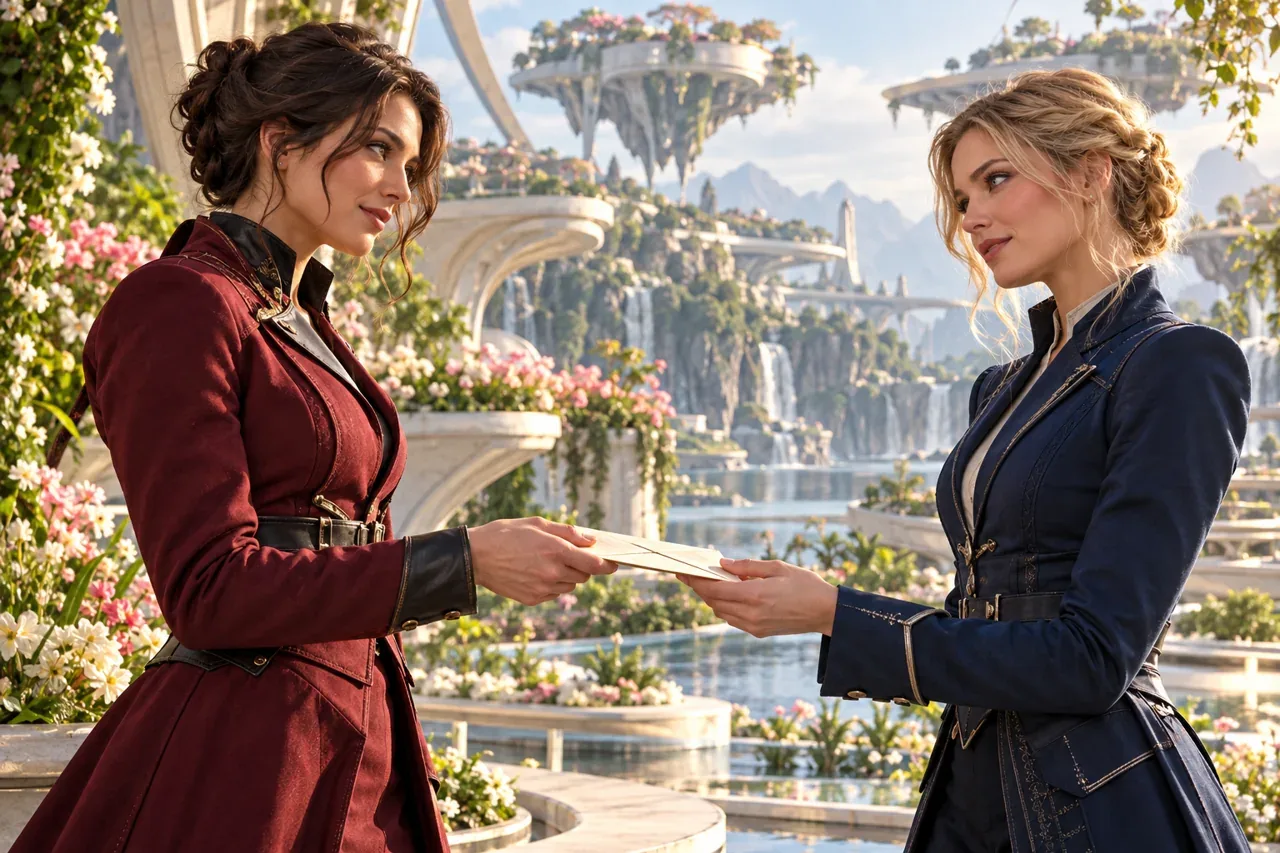
After one battle, Red finds a note left for her by her opposite number. It is a taunt. She writes back. Soon the two are trading letters hidden in seeds, tea leaves and the rings of trees, each message a dare and then a confession. What starts as a game between rivals becomes something far more dangerous for both of them, because if either side finds out, the letters are treason.
What Makes This Enemies to Lovers Romance Work
This Is How You Lose the Time War hooks readers with its form. The love story lives almost entirely in letters, and the letters are hidden in absurd, beautiful places. Spines in a Line loved those imaginative message forms, and they turn each chapter into a small puzzle.
The enemies to lovers arc is pure escalation. Red and Blue start by mocking each other and end up writing things they could be executed for. Publishers Weekly, as quoted on Wikipedia, called the book exquisitely crafted, and noted how the wordplay shifts from challenge to endearment. That shift is the whole romance, and you watch it happen in the salutations.
And it is short. At just over 200 pages, the book is a novella that does the emotional work of a much longer romance, which is part of why it went viral again in 2023 when a fan's posts sent it to the top of Amazon's science fiction chart, according to Wikipedia. If you want sapphic romance that is literary and strange, start here.
My Review
I have read This Is How You Lose the Time War more than once, and each time I notice something new in the letters, a joke that is also a love note, a sign-off that means more than it says. It is not a comfortable book, and it is not a conventional romance. It is the most devoted one I know.
Romance and Chemistry
The romance is built from attention. Red and Blue fall for each other by reading closely, quoting each other's favorite books back, catching each other's references. Andy Sawyer at Vector described their journey from mocking adversaries to passionate if distanced lovers, and the distance is the point: they almost never share a room, so every letter carries the full weight of wanting.
It is also genuinely enemies to lovers. They are on opposite sides of a war that destroys entire timelines, and neither of them is innocent. Jason Sheehan at NPR wrote that the letters are funny, tender and dangerous at once, and the danger is real. When the war notices them, the book shifts gear into something close to a thriller, and the last third is as tense as anything I have read in romance.
The Characters
Red and Blue are drawn mostly through voice. Max Gladstone wrote Red's letters and Amal El-Mohtar wrote Blue's, according to Wikipedia, and the two voices are distinct: Red is sharper and more guarded, Blue more extravagant and teasing. Sheehan noted they are different enough to feel separate but similar enough to suggest the same exhaustion.
Not everyone hears the difference. Alan K. Dell, who disliked the book, found the leads hard to tell apart, and I can see how the ornate style flattens them for some readers. Shannen at Rekindled Bibliophile struggled with the abstract setting at first, then found the letters grounding her. That is my experience too. The characters are not built from backstory or family. They are built from what they choose to say to one person.
Writing and Pacing
The prose is lush, allusive and full of wordplay, and it is the book's great strength and its main dividing line. imyril at There's Always Room for One More responded to its poetry and emotional urgency; Dell called it overwrought and at times nonsensical. Both are describing the same sentences. If you like your romance plain, this is not for you.
The worldbuilding is deliberately thin. Ross O'Brien at Starburst found the factions and campaigns shallow, and NPR's Sheehan noted the book never explains the how or why of the war. I think that is a choice, not a failure: the war is weather, and the letters are the story. Pacing is quick; it reads in a sitting. The ending pulls the threads together in a way that changes how you read earlier letters, though Black Gate felt the final reveal could be guessed early, per Wikipedia.
This Is How You Lose the Time War is a brilliant, heartfelt love story in letters that gives up sex scenes and solid worldbuilding for yearning and language. Read it if you love beautiful prose and devotion that builds one sentence at a time; skip it if you want your science fiction concrete.
How Spicy Is This Is How You Lose the Time War?
This Is How You Lose the Time War is a 1 out of 5 on our scale: Kisses only / closed door. There is no on-page sex. The romance is expressed in letters, and the desire in them is intense, but physical intimacy is almost entirely absent from the page.
The heat here is emotional and verbal, not physical, which suits the form. The book is still sensual in its language, so it is not a sweet romance in tone. Readers looking for closed-door love stories will find it a good fit; see our closed door picks for more, and our heat levels guide explains the scale.
Content warnings, drawn from reader reports and our own read:
- War, violence and mass death across timelines
- Torture
- Blood and injury
- Animal deaths
- Self-harm
- Poisoning
- Characters committing acts of violence for their side
Our content warnings guide explains how we compile these lists.
Who Should Read This Is How You Lose the Time War?
This Is How You Lose the Time War suits readers who want a short, literary, sapphic love story with yearning, wordplay and rival lovers on opposite sides of a war. It is less suited to readers who want clear science fiction mechanics, plain prose or an explicit romance.
Best for:
- Fans of sapphic enemies to lovers and slow burn yearning
- Readers who love epistolary novels and wordplay
- Anyone who wants a romance they can finish in an afternoon
- Readers of literary science fiction
Not for:
- Readers who need detailed, rule-based worldbuilding
- Anyone who finds ornate prose tiring
- Readers who want explicit heat (try our spicy picks)
- Readers who need a conventional, tied-up HEA
What Readers and Critics Are Saying
This Is How You Lose the Time War is one of the most decorated science fiction books of its year. It won the Nebula Award and BSFA Award for 2019, and the Hugo and Locus awards in 2020, according to Wikipedia, and was a finalist for the Los Angeles Times Ray Bradbury Prize. NPR's Jason Sheehan said the characters write like they have seen the beginning and the end of time.
Where they agree. The letters and the emotional force. Publishers Weekly praised the language, inventive structure and emotional power, and Andy Sawyer at Vector called it almost certainly the best book he read that year. Even mixed reviews tend to admire the love story.
Where they split. The prose and the war. Alan K. Dell could not recommend it at all, calling the prose overwrought, the world insubstantial and the stakes weak, while still praising its poetic yearning. Ross O'Brien at Starburst found the factions shallow. Black Gate thought the final twist was guessable, and Spines in a Line needed time to get oriented before the later reveals paid off.
The Eikna Evidence Scorecard
This Is How You Lose the Time War scores 8.9 out of 10 on the Eikna Evidence Scorecard, with top marks for writing and emotional impact and strong scores for romance and rereads, held back slightly by thin characterization for some readers and an open ending.
| Dimension | Score (/5) | Why |
|---|---|---|
| Romance (20%) | 4.5 | Rivals to devoted lovers in letters, per Vector; physically distant by design. |
| Characters (15%) | 4 | Two distinct voices per NPR; hard to tell apart for some, per Alan K. Dell. |
| Writing and pacing (15%) | 5 | Award-winning prose and structure, exquisitely crafted per Publishers Weekly. |
| Emotional impact (15%) | 5 | Emotional force praised by Publishers Weekly and There's Always Room for One More. |
| Heat level (10%) | 4 | Delivers the intense, nonphysical yearning it promises; no sex on page. |
| Ending satisfaction (15%) | 4 | Hopeful and clever, but open; Black Gate found the final reveal guessable. |
| Reread appeal (10%) | 4.5 | Short and layered; imyril plans a slower reread, and later reads reward attention. |
The Eikna Overall Ranking: This Is How You Lose the Time War sits near the top of the sapphic and science fiction romances we have reviewed, and among the most influential love stories in recent genre fiction, landing at a final Eikna Score of 8.9/10.
Is This Is How You Lose the Time War a Standalone?
Yes. This Is How You Lose the Time War is a complete standalone novella with no sequel or series. Red and Blue's story begins and ends in one book, and you need nothing else to read it.
Best format: print or ebook first, so you can linger over the letters and flip back to earlier ones once the ending lands. The audiobook, narrated by Cynthia Farrell and Emily Woo Zeller, runs about 4 hours 15 minutes and uses two voices for the two agents, which makes it a strong choice for a reread. For more on happy and hopeful endings, see our HEA and HFN guide.
If You Loved This Is How You Lose the Time War, Read These Next
If you loved This Is How You Lose the Time War, look for romances built on letters, rivals and time slipping out of joint.
- The Undertaking of Hart and Mercy by Megan Bannen: rivals who fall for each other through anonymous letters.
- One Last Stop by Casey McQuiston: a sapphic romance with a woman stuck out of time on a subway train.
- The Ministry of Time by Kaliane Bradley: a time travel love story with sharp prose and a government agency.
- Red, White & Royal Blue by Casey McQuiston: rivals whose romance grows through emails and secret messages.
- The Flatshare by Beth O'Leary: two strangers who fall in love through notes left around a shared flat.
Frequently Asked Questions
This Is How You Lose the Time War prompts the same questions from most readers: whether it is a romance, how spicy it is, how it ends and whether a show is coming. Short answers below.
Is This Is How You Lose the Time War a romance?
Yes. It is a love story between two women at its core, told through letters, though it is shelved as science fiction.
Is This Is How You Lose the Time War spicy?
No. It is a 1 out of 5 on our scale, with no on-page sex; the desire lives in the letters.
Does This Is How You Lose the Time War have a happy ending?
It has a hopeful, open ending that we class as happy for now rather than a conventional happily ever after.
Is This Is How You Lose the Time War a standalone?
Yes. It is a complete standalone novella with no sequel.
Who wrote which character in This Is How You Lose the Time War?
Max Gladstone wrote Red's letters and Amal El-Mohtar wrote Blue's, according to Wikipedia.
Is This Is How You Lose the Time War being adapted?
It was optioned for television in 2019, with the authors set to write the scripts, but we found no confirmed release.
How long is This Is How You Lose the Time War?
About 208 pages in hardcover and 224 in trade paperback; the audiobook runs about 4 hours 15 minutes.
The Bottom Line
This Is How You Lose the Time War earns an 8.9/10 and a Highly recommended badge. It is for readers who want a short, literary, sapphic love story with rivals, yearning and language that rewards rereading, and who can live without explicit heat or solid worldbuilding. The reason to pick it up is the letters: few romances have ever made falling in love feel so much like reading.
Buy on Amazon Buy at Bookshop.org Listen on Audible Listen on Libro.fm
Some links on this page are affiliate links: Eikna Romance may earn a small commission at no extra cost to you.
Sources
- This Is How You Lose the Time War, Wikipedia
- This Is How You Lose the Time War, Simon & Schuster
- This Is How You Lose the Time War, Publishers Weekly
- Letters serve to bond time-traveling rivals, NPR (Jason Sheehan)
- Review: This Is How You Lose the Time War, Vector (Andy Sawyer)
- Book review: This Is How You Lose the Time War, Alan K. Dell
- This Is How You Lose the Time War audiobook, Libro.fm
Reader reviews by Ross O'Brien (Starburst), imyril (There's Always Room for One More), Shannen (Rekindled Bibliophile) and Spines in a Line, and their content notes. Publishers Weekly and Black Gate are cited as summarized by Wikipedia.
How we review: every Eikna score is built from a seven-part evidence scorecard. Read our methodology.