Start with Outdrawn for co-lead artists, Weather Girl for colleagues facing the same difficult management, or Headliners for cohosts whose contracts depend on a separate boss. These eight workplace romances avoid a current boss–direct-report setup in the roles described by their sources. Two promotion rivals come with a separate warning: winning could change that balance.
Spoiler level: job roles, professional history and promotion stakes. We name who supports each role check and keep the outcome of competitions out of the notes. Equal footing here concerns formal employment authority; reputation, seniority, publicity and money can still matter. This is a researched comparison, not a firsthand audit of every scene or a promise that every career stays unchanged.
Editorial rivalry illustration, not a scene from a listed book.
Sage has years of seniority and expected sole creative control. The published arrangement gives them shared credit, rather than making the newcomer her employee.
Separate bakery owners and fellow television judges
Their history begins when Dominic judged Sylvie as a contestant. The current romance's arrangement changes that earlier hierarchy; it does not erase it.
A teaching PhD student and a university security guard
They have different jobs and career stages. His safety role is not academic supervision, and she is not his manager. Publicity for his charity creates a separate negotiation.
Marketing colleagues competing for a new director role
The prize changes professional rank. This is another peer-start choice, with later authority deliberately left unpromised.
What we mean by equals at work
The useful question is what one person can decide about the other. Hiring, firing, pay, discipline, evaluation and promotion are formal powers. Being older, more experienced or better known is different, though it can still make a refusal harder. The notes below separate the actual role from those surrounding pressures.
Different employers count when the work materially shapes the relationship: rival bakery owners repeatedly compete and judge together; opposing hockey captains share a league and a public rivalry. A person merely having a job would not be enough. The workplace romance hub covers the wider setting question.
Sources can establish a shared role or a separate decision-maker without certifying every later interaction. We retain that limit. If your boundary rules out any possible future hierarchy, skip the promotion section. If indirect influence is also a hard limit, read the authority note rather than relying on the word coworker.
Peer arrangements with different pressures
These six choices establish a shared professional level or separate employers in their checked roles. Their cautions explain what the absence of a direct reporting line leaves unresolved.
Outdrawn
Deanna Grey
Cover shown: Tantor audiobook edition
Co-lead comic artists at Harpy
Choose it for creative disagreement that has to become collaboration. Noah's new job puts her beside the artist she has competed with since college, while their personal webcomics remain rivals too. Deadlines, credit and whose ideas are heard keep the work central to the romance.
Role evidence: Emory Rose at the Lesbrary explicitly describes a shared head-artist role and both seeking their higher-ups' approval; Vic independently describes Sage as co-lead.
Authority and influence: Sage has years of seniority and expected sole creative control. The published arrangement gives them shared credit, rather than making the newcomer her employee.
Check before choosing: A shared title does not erase seniority, burnout or industry pressure. The role evidence concerns the shared assignment, with later career decisions left unpromised.
As an Amazon Associate, Eikna Romance earns from qualifying purchases. We may also earn from other retailer links, at no extra cost to you. Search buttons are tracked searches; editions vary. Unverified Bookshop positions are disabled. Covers may differ from the format you find.
Start here when you want two colleagues on the same side of a workplace problem. Ari and Russell try to improve a newsroom dominated by their bosses' difficult history, and the scheme gives them reasons to spend time together away from the broadcast.
Role evidence: Kirkus identifies Ari and Russell as colleagues responding to their bosses' conflict. Penguin's synopsis names the weather mentor and news director as the people above them.
Authority and influence: Different departments and shared frustration do not mean identical experience or security. The station's management creates the pressure.
Check before choosing: Mental health and family responsibilities also matter. Peer roles are not a low-angst, no-breakup or no-conflict promise.
Rival presenters assigned to co-host one morning show
Choose this for broadcast teamwork under an external deadline. Sabrina and Nick must improve a struggling show while working around on-set mishaps, an audience that enjoys their feud and their own very public reputations.
Role evidence: Lucy Parker names them cohosts. Caz Owens at All About Romance identifies their immediate boss as the person who decides whether their contracts are renewed.
Authority and influence: Nick has previously aired Sabrina's family scandal. They are professional peers, but publicity can damage a career without a reporting line.
Check before choosing: London Celebrities book 5. Owens recommends The Austen Playbook first because this story carries its fallout; allow for that earlier context.
Separate bakery owners and fellow television judges
Pick this if you want professionals defending different ways of doing the same craft. Glittery invention and precise tradition clash in the kitchen and on television, while one royal contract gives their rivalry a concrete cost.
Role evidence: Kirkus confirms Sylvie returns as a judge opposite Dominic. All About Romance distinguishes their competing bakeries and their collaboration on research for the wedding-cake tender.
Authority and influence: Their history begins when Dominic judged Sylvie as a contestant. The current romance's arrangement changes that earlier hierarchy; it does not erase it.
Check before choosing: Their separate businesses repeatedly bring them together as competitors and collaborators. Palace Insiders book 1; this entry is not a promise that the whole series is finished.
A teaching PhD student and a university security guard
Try this for a campus romance outside the professor-and-student pattern. A fire-drill rescue becomes a viral clip, giving a busy academic and a romance-loving former rugby player a reason to fake a relationship.
Role evidence: Talia Hibbert identifies Dani as a PhD student and Zaf as a security guard. Kirkus specifies that Dani teaches in his building, rather than being his student or employee.
Authority and influence: They have different jobs and career stages. His safety role is not academic supervision, and she is not his manager. Publicity for his charity creates a separate negotiation.
Check before choosing: Dani's academic ambition and Zaf's mental-health history remain part of the story. Brown Sisters book 2. Peer roles say nothing about exclusivity, sexual detail or career closure.
Choose this when the workplace is the sport rather than a shared office. A public rivalry and private attraction create different rules for the same two men, with professional ambition making visibility costly.
Role evidence: Rachel Reid explicitly names Shane captain of Montreal and Ilya captain of Boston. Their rivalry crosses employers; neither is the other's team manager.
Authority and influence: Secrecy and the league's public culture can threaten both careers. Equal professional status does not remove those external pressures.
Check before choosing: Game Changers book 2. Their relationship continues in The Long Game, so choose it ready for more time with this couple. Equal professional roles do not settle their relationship boundaries.
These two belong in a clearly flagged section. The competition begins between colleagues, but the prize can alter rank. They are useful comparisons for readers comfortable with that possibility, rather than recommendations for an absolute no-hierarchy rule.
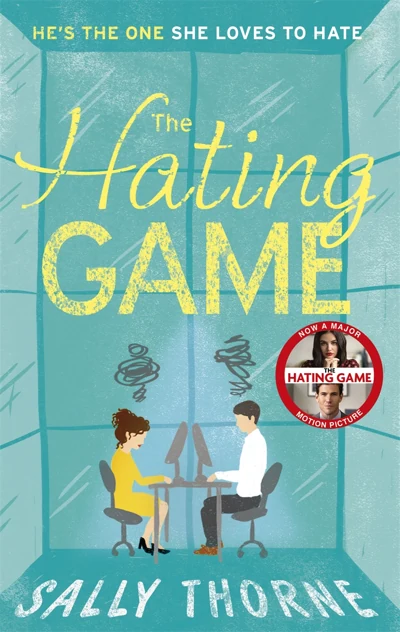
The Hating Game
Sally Thorne
Executive assistants competing for one promotion
Start here for office rivalry with a visible prize. Lucy and Joshua turn their daily proximity into a sequence of contests, until the promotion makes losing much more consequential than another exchanged glare.
Role evidence: Sally Thorne's exact-title page explicitly says Lucy would become Joshua's boss if promoted. Their current shared-office rivalry is the peer starting point.
Authority and influence: This is a promotion-risk choice, not a guarantee of unchanged equality. Skip it if even a possible later reporting line crosses your boundary.
Check before choosing: The promotion warning is a premise-level spoiler; its winner and the ending stay undisclosed. No claim that every scene lacks influence or that the final roles stay the same.
Marketing colleagues competing for a new director role
Pick it for a work assignment that makes an online rivalry physical. Henley and Graeme must turn their Galapagos experience into a marketing proposal, with the competition following them beyond the office.
Role evidence: The publisher's sample names James as their shared boss. Publishers Weekly confirms he assigns a cruise-based proposal competition for the same promotion.
Authority and influence: The prize changes professional rank. This is another peer-start choice, with later authority deliberately left unpromised.
Check before choosing: The premise includes disputed professional credit and perceived favoritism. Those matter even before either person has formal authority. No ending or promotion outcome revealed.
Why other workplace favorites are outside this selection
Professional rivalry alone does not settle authority. Love, Theoretically includes hiring-committee power. Book Lovers involves commercial acquisition decisions, which can affect an agent's clients even across employers. We leave both outside this narrower comparison. A producer–presenter pairing also needs its actual decision-making duties checked before it receives an equals label.
For a relationship where authority is part of the attraction, use the boss–employee guide. For competition across more settings, browse rivals-to-lovers. Our women-athlete guide follows the athlete's career without treating a captain and a rookie as identical in influence.
Questions about workplace romance between equals
Does a coworker romance have no power imbalance?
Not automatically. Coworker can describe people with very different control over schedules, evaluations or contracts. This guide names the checked role, flags indirect influence and separates promotion risks. It does not turn a shared employer into a universal equality guarantee.
Does seniority make someone the other person's boss?
Not by itself. Outdrawn distinguishes a long-established artist from a new colleague sharing the head-artist role. Experience affects their rivalry, but the named assessments place both beneath separate higher-ups. That specific arrangement matters more than the general word senior.
What about two people competing for the same promotion?
Check what the winning role would control. The Hating Game explicitly raises the possibility of Lucy becoming Joshua's boss. Shipped also places a higher-ranking job at stake. Both are flagged peer-start comparisons, with the outcome left undisclosed.
Does equal footing guarantee a gentle story or a happy career ending?
No. Management conflict, secrecy, public scandal and competition can still create strain. A relationship outcome and professional stability are separate questions. Use the conflict guides and ending guide for those preferences.