Gabriel's Inferno by Sylvain Reynard Review
Eikna Score: 6.7/10. Recommended with reservations.
Gabriel's Inferno is a long, ornate redemption romance that asks you to fall for a Dante professor who behaves badly for much of the book. Readers who surrender to its slow burn and its literary furniture call it a favorite; readers who cannot get past the prose or the power gap tend to quit early.
Read it if you want a slow, swooning professor romance steeped in Dante and Florence, or you like a damaged hero working hard for forgiveness. Skip it if a professor dating his own graduate student is a hard no, or you have no patience for a 576 page book with a deliberately old-fashioned voice.
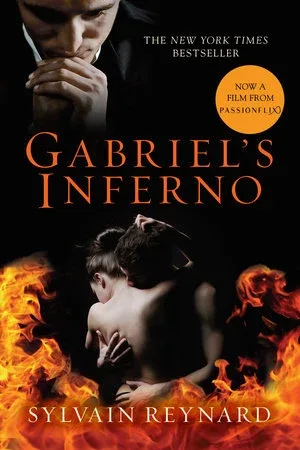
Gabriel's Inferno at a Glance
Gabriel's Inferno is book 1 of Sylvain Reynard's Gabriel's Inferno series, first published by Omnific in 2011 and reissued by Berkley in September 2012. It pairs Dante scholar Professor Gabriel Emerson with his graduate student Julia Mitchell, is a long slow burn with moderate heat, and ends with the couple together and their story continuing.
| Author | Sylvain Reynard (pen name of an anonymous Canadian author) |
|---|---|
| Series | Gabriel's Inferno, book 1 of 4 (same couple throughout) |
| Subgenre | Contemporary romance (academic, literary) |
| Main tropes | Professor and student, forbidden love, slow burn, tortured hero redemption, a past connection |
| Spice level | 3/5: Moderate, some open door |
| Content warnings | Professor and grad student power imbalance, controlling behavior, substance misuse history, trauma (full list below) |
| POV | Third person, moving between Julia and Gabriel |
| Ending | HFN; the couple is together and the story continues in Gabriel's Rapture |
| Pages | 576 (Berkley paperback) |
| Audiobook | Narrated by John Michael Morgan, 20 hours 24 minutes (Penguin Audio) |
| First published | 2011 (Omnific); Berkley edition September 4, 2012 |
| Publisher | Berkley (Penguin Random House) |
What Is Gabriel's Inferno About?
Gabriel's Inferno follows Julia Mitchell, a shy first year master's student who arrives at the University of Toronto to study Dante. Her new supervisor is Professor Gabriel Emerson, a celebrated Dante specialist who is cold and cutting in the seminar room and, according to the publisher, hedonistic everywhere else.
Gabriel believes he is past saving. Julia has reasons of her own to be guarded. What neither can quite shake is a connection between them that started long before the semester did. As attraction grows, Gabriel's job, his reputation and his secrets all come under pressure, and the novel asks whether a man who thinks he belongs in hell can be pulled out of it.
What Makes This Professor and Student Romance Work
Gabriel's Inferno works as a professor and student romance because it leans all the way into the literary fantasy. This is not a quick campus hookup. It is a book about Dante and Beatrice, Florentine art, good wine and the idea that love can be a kind of grace, and Reynard builds the romance on top of that frame.
The forbidden element is serious here. Gabriel has real power over Julia's academic future, and the book knows it, which is why the tension holds for so long. The hero's arc is pure redemption: a man who has done damage, believes he deserves punishment and slowly learns to accept being loved.
It also helps to know where the book came from. Wikipedia notes that it began as Twilight fan fiction before Omnific and then Berkley published it, and it rode the same wave of interest as Fifty Shades of Grey onto the New York Times list. Readers who love slow burn and the swoon of a brooding older hero will see the appeal straight away.
My Review
Gabriel's Inferno is a book I respect more than I enjoy. It is ambitious in a way a lot of professor romances are not, and it gives its readers exactly the immersive, swooning experience they came for. It also tests patience, mine included, in its first third.
The book is long. At 576 pages in the Berkley edition and more than twenty hours on audio, it takes its time over dinners, lectures, gifts and misunderstandings. If that sounds like heaven, you are the reader this book was written for.
Romance and Chemistry
The chemistry is built on longing more than banter. Gabriel is hostile, then protective, then devoted, and the swings are sharp. Julia is quiet and principled, and much of the romance plays out in what she does not say. When the two finally stop circling, the payoff feels earned in a way that only a slow burn can manage.
But the power dynamic is impossible to ignore, and I do not think the book fully reckons with it. Gabriel is Julia's professor and holds sway over her program. He is also jealous and controlling in early chapters in ways the narrative often frames as passion. Some StoryGraph readers stopped reading over exactly this, and their objection is fair. More Than a Review, which liked the book, still spent real time on Julia's agency and how much room she is given to choose.
The Characters
Gabriel is the main event. He is arrogant, wounded, generous and difficult, and his history with addiction and guilt gives the redemption arc weight. Julia is harder to know. She is kind and stubborn, but for long stretches she reacts more than she acts, and I wanted more of her inner life. The supporting cast, especially Gabriel's adoptive family and Julia's friend Paul, give the book some needed warmth.
The reviewer at Cannonball Read, who read the whole series, wrote "I inhaled the books" and praised its handling of recovery from trauma. That is the best case for these characters: they heal slowly and visibly over several volumes.
Writing and Pacing
The prose is the dividing line. Reynard writes in a formal, mannered voice full of Italian phrases, art history and lines from the Divine Comedy. Some readers find it transporting. The Aestas Book Blog reviewer gave the story four stars but knocked one off for the writing style, which left them feeling like an outsider, and decided not to continue the series. I understand both reactions. The voice is distinctive and occasionally beautiful, and it is also slow and repetitive in the middle.
Pacing picks up in the final third, when the world outside the couple starts pushing back. The last chapters are the strongest in the book.
Gabriel's Inferno is a lush, polarizing redemption romance whose literary ambition is real and whose power imbalance is a genuine problem. Read it if you want to be swept into a long slow burn and can live with a hero who has a lot to answer for.
How Spicy Is Gabriel's Inferno?
Gabriel's Inferno is a 3 out of 5 on our scale: Moderate, some open door. For most of the book the heat is in looks, touches and restraint. The intimate scenes arrive late in a very long novel, and they are written in a lush, romantic register rather than a blunt one. The later books in the series carry more of the explicit content.
The bigger consideration is consent in context. Julia is Gabriel's graduate student when the attraction begins, and Gabriel's early behavior includes controlling and jealous moments. For more on how we rate heat, see our romance heat levels guide.
Content warnings, drawn from reader reports:
- Professor and graduate student power imbalance
- Controlling and jealous behavior
- Substance misuse in the hero's past
- Past trauma for both leads
- Stalking or surveillance themes
- Religion, guilt and shame
- Sexual content
Our content warnings guide explains how we compile these lists.
Who Should Read Gabriel's Inferno?
Gabriel's Inferno suits readers who want a long, immersive professor romance with literary references, a tortured older hero and a redemption arc that runs across several books. It is less suited to readers who want brisk pacing, modern prose or a clean power balance between the leads.
Best for:
- Readers who love Dante, Florence and art history woven into romance
- Fans of tortured heroes seeking redemption
- Anyone who wants a slow burn that takes its time
- Readers happy to follow one couple across four books
- Fans of the Passionflix film adaptation
Not for:
- Readers uncomfortable with a professor dating his current student
- Anyone who dislikes controlling or jealous heroes
- Readers who want fast pacing or spare prose
- People looking for a short, self-contained story
What Readers and Critics Are Saying
Gabriel's Inferno was a genuine phenomenon. According to Wikipedia, the series reached the New York Times bestseller list, and in October 2012 the first two books sat at 12th and 17th on its trade paperback fiction list. Fans have organized Inferno inspired tours of Toronto, and Passionflix adapted it into three films in 2020.
Where they agree. The book is immersive. Cannonball Read admitted to inhaling the series, Aestas Book Blog liked the story even while doubting the prose, and More Than a Review and Itsy Bitsy Book Bits praised the strength of the central relationship and the redemption arc.
Where they split. Style and power. Aestas found the writing distancing; some StoryGraph readers did not finish because of the length and Gabriel's behavior. Itsy Bitsy Book Bits flagged a serious pressure point in how the relationship starts. Wikipedia also records some readers objecting to fan fiction being sold for profit, the same complaint aimed at Fifty Shades.
The Eikna Evidence Scorecard
Gabriel's Inferno scores 6.7 out of 10 on the Eikna Evidence Scorecard. Its best marks go to romance, emotion, heat and ending, where its devoted readers agree it delivers, and its lowest to characters and writing, where Julia's passivity and the ornate prose drag it down.
| Dimension | Score (/5) | Why |
|---|---|---|
| Romance (20%) | 3.5 | A long, earned slow burn; some StoryGraph readers object to the power gap. |
| Characters (15%) | 3 | Gabriel is vivid, Julia often passive; More Than a Review weighs her limited agency. |
| Writing and pacing (15%) | 3 | Distinctive but slow and mannered; Aestas Book Blog docked a star for the style. |
| Emotional impact (15%) | 3.5 | The redemption arc lands; Cannonball Read praises its handling of trauma. |
| Heat level (10%) | 3.5 | Restrained and romantic, as promised; the heat stays modest until late. |
| Ending satisfaction (15%) | 3.5 | A hopeful close with the couple together, but the story keeps going. |
| Reread appeal (10%) | 3.5 | Devoted fans reread the whole series; casual readers rarely finish once. |
The Eikna Overall Ranking: Gabriel's Inferno is the founding book of its series and the one that matters most, but it sits in the middle of the professor romance field for us because of its pacing and power gap, at a final Eikna Score of 6.7/10.
Gabriel's Inferno Series Reading Order
Gabriel's Inferno is book 1 of four in Sylvain Reynard's series about Gabriel and Julia, and you must start here. The books follow the same couple, so read them in order.
- Gabriel's Inferno (2011; Berkley 2012)
- Gabriel's Rapture (September 2012)
- Gabriel's Redemption (December 2013)
- Gabriel's Promise (January 2020)
Best format: print, if you want to linger over the Dante quotations and Italian, or the John Michael Morgan audiobook (about 20 hours 24 minutes) if you want the length to feel shorter. Passionflix released a three part film of Gabriel's Inferno in 2020, with Melanie Zanetti as Julia and Giulio Berruti as Gabriel, followed by Gabriel's Rapture and Gabriel's Redemption. Our series order guide covers more series.
If You Loved Gabriel's Inferno, Read These Next
If you loved Gabriel's Inferno, try other academic romances with forbidden attraction, from the gentler to the more intense.
- An Academic Affair by Jodi McAlister: rival academics and a funny, sharp look at university power.
- Kissing Tolstoy by Penny Reid: a shorter, lighter professor and student romance that also takes its rules seriously.
- Beautiful Mistake by Vi Keeland: a professor, his teaching assistant and a hidden shared past.
- Professor Astor by Catharina Maura: a one night stand who turns out to be her PhD supervisor.
- The Love Hypothesis by Ali Hazelwood: academic romance with a brooding older hero and much less moral weight.
Frequently Asked Questions
Gabriel's Inferno draws the same questions from new readers: how spicy it is, how the series works, whether it has a happy ending and how to watch the film.
Is Gabriel's Inferno spicy?
Moderately. Gabriel's Inferno is a 3 out of 5 on our scale, a long slow burn with the intimate scenes arriving late and written romantically rather than bluntly.
What is the Gabriel's Inferno series order?
Gabriel's Inferno, Gabriel's Rapture, Gabriel's Redemption, then Gabriel's Promise. All four follow Gabriel and Julia.
Does Gabriel's Inferno have a happy ending?
It ends hopefully, with Gabriel and Julia together, but their story continues directly in Gabriel's Rapture.
Is Gabriel's Inferno based on fan fiction?
Yes. It began online as Twilight fan fiction before it was published by Omnific and later Berkley.
Is there a Gabriel's Inferno movie?
Yes. Passionflix released Gabriel's Inferno as three films in 2020, starring Melanie Zanetti and Giulio Berruti.
Is there a Gabriel's Inferno audiobook?
Yes. Penguin Audio's edition is narrated by John Michael Morgan and runs 20 hours 24 minutes.
The Bottom Line
Gabriel's Inferno earns a 6.7/10 and a Recommended with reservations badge. It is for readers who want a long, literary, slow burning professor romance and can accept a hero whose early behavior is part of what he must be redeemed from. The one reason to pick it up is the atmosphere: Dante, Florence and longing, sustained across a book that never apologizes for its own intensity.
Buy on Amazon Buy at Bookshop.org Listen on Audible Listen on Libro.fm
Some links on this page are affiliate links: Eikna Romance may earn a small commission at no extra cost to you.
Sources
- Gabriel's Inferno, Penguin Random House (edition, pages, audiobook)
- Gabriel's Inferno, Wikipedia (publication history, bestseller lists, film)
- Gabriel's Inferno audiobook, Libro.fm
- Gabriel's Inferno audiobook, Audible
- Gabriel's Inferno review, Aestas Book Blog
- Gabriel's Inferno series review, Cannonball Read
- More Than a Review, Itsy Bitsy Book Bits and StoryGraph reader reviews
How we review: every Eikna score is built from a seven-part evidence scorecard. Read our methodology.