Losing It by Cora Carmack Review
Eikna Score: 6.6/10. Recommended with reservations.
Losing It is a quick, awkward, often funny new adult romance about a theatre student who bolts from her own one-night stand and then finds the man she left behind teaching her class. The comedy mostly lands; the romance runs on attraction more than depth, and the teacher and student setup will be a dealbreaker for some.
Read it if you want a short, cringe-comedy romance with a British leading man and a heroine who narrates her own panic, or you are curious about one of the books that launched new adult. Skip it if a romance with a current professor is a hard limit, or nervous, self-deprecating narrators wear you out.
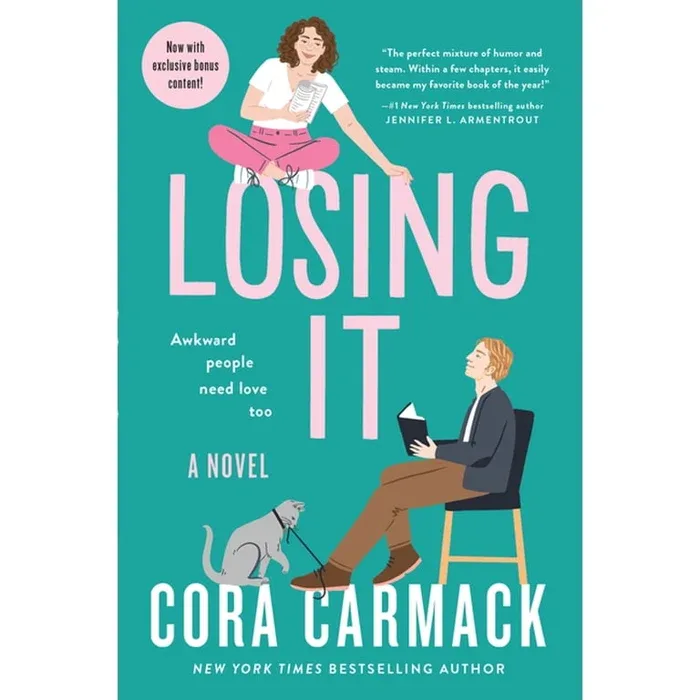
Losing It at a Glance
Losing It is book one of Cora Carmack's Losing It series, a new adult contemporary romance first self-published in October 2012 and reissued in a revised edition in April 2023. It is a forbidden professor and student romance told in Bliss's first person voice, with moderate open-door heat and an HEA.
| Author | Cora Carmack |
|---|---|
| Series | Losing It, book 1 (each main book follows a different friend) |
| Subgenre | Contemporary romance (new adult, college theatre) |
| Main tropes | Forbidden love, professor and student, one-night stand gone wrong, virgin heroine, British hero |
| Spice level | 3/5: Moderate, some open door |
| Content warnings | Relationship with a current professor, virginity pressure, alcohol, secrecy (full list below) |
| POV | First person, Bliss |
| Ending | HEA (what that means) |
| Pages | 272 (2023 revised paperback) |
| Audiobook | Narrated by Phoebe Strole, 6 hours 14 minutes (Avon, 2013) |
| First published | October 2012 (self-published); revised edition April 25, 2023 |
| Publisher | Avon, an imprint of HarperCollins (originally self-published, then William Morrow) |
What Is Losing It About?
Losing It follows Bliss Edwards, a college senior heading into her final semester who is tired of being the only virgin among her friends. She decides to fix that with a one-night stand, picks a handsome British stranger and then freezes. She makes a terrible excuse and leaves him naked in her bed.
The next day she walks into her theatre class and finds that the stranger is her new professor, Garrick. Now she has to finish the semester, keep her friends out of it and pretend she is not thinking about the man at the front of the room, all while working out what she wants once school is over.
What Makes This Forbidden Love Romance Work
Losing It works because its forbidden love setup is played as farce before it is played as romance. Most professor and student books open with longing glances. This one opens with a heroine making up a reason to flee her own apartment, and the shame of that scene powers the first half of the book.
The voice is the hook. Bliss narrates in a nervous, self-mocking first person, and Rowena at Book Binge praised her as strong, smart, funny and relatable precisely because she is not polished. Garrick is British, calm and amused by her, which makes for a clean comic contrast.
The timing also helps. Bliss is weeks from graduating and terrified of what comes next, so the forbidden attraction sits on top of a more ordinary fear. Readers who like forbidden love stories that keep the angst light will find this an easy afternoon read.
My Review
Losing It is a book I liked more for its first fifty pages than for its last hundred. The opening is genuinely funny: Bliss's plan, Bliss's panic, Bliss's excuse, and then the slow horror of recognizing her new professor. Cora Carmack writes embarrassment well, and embarrassment is the engine of the whole first act.
Once the comedy settles, the book has to become a romance, and that is where it thins out. Into the Hall of Books found it funny and quick but occasionally rolled its eyes at Bliss's neurosis, and a Target reviewer of the revised paperback found the awkwardness unromantic. I land in between. I laughed, and I never quite believed in the couple as much as I believed in Bliss's mortification.
Romance and Chemistry
The attraction is immediate and Carmack does not pretend otherwise. Garrick is patient, teasing and clearly smitten, and the scenes where they almost give in are the most charged in the book. What is missing is friction of a deeper kind. Their obstacles are external, his job and her status, and when those ease, there is less between them than the setup promised.
The power imbalance matters too. He is her current professor, and while the book keeps them close in age and treats them as adults, some readers will not get past it. Rowena at Book Binge accepted the dynamic for that reason but found Garrick's jealousy eye-roll worthy at times, and I agree. His possessive streak is the least appealing thing about him.
The Characters
Bliss is the book. Her anxiety about sex, about graduating and about her friends is written with real sympathy, and her voice keeps the pages turning. The Reading Date valued the awkward comedy and her next-step anxiety, and that pairing is the most grounded part of the novel. If you find her exhausting, the book will be exhausting, because she narrates every page.
Garrick is pleasant and thin. He is handsome, British, kind and good at his job, and not much else comes through in Bliss's point of view. The supporting cast does better. Rowena singled out Cade and Kelsey, and both get more space later in the series. Their friendship drama is the subplot I cared about most.
Writing and Pacing
Losing It is short, around 270 pages in the revised edition, and it reads fast. Rowena found the beginning slow, though for me it was the middle that sagged, after the reveal and before the stakes sharpen. Older reviews praised the accessible shape but called the plot formulaic, which is fair. You can see the ending coming, and the book does not try to hide it.
The 2023 edition was re-edited with minor updates throughout and adds a new epilogue, according to Carmack's newsletter. If you are choosing between editions, that is the one to get.
Losing It is a breezy, funny new adult romance that is stronger as a comedy of embarrassment than as a love story. Read it if a professor romance is fine for you and you want something light and quick.
How Spicy Is Losing It?
Losing It is a 3 out of 5 on our scale: Moderate, some open door. Carmack's own copy calls the romance steamy, and there is on-page sexual content between two consenting adults, but the book spends more time on near misses and nerves than on explicit scenes.
Consent is clear throughout, and Bliss's choice to stop on the first night is respected. The bigger issue for many readers is the setup itself: a relationship between a student and her current professor. See our heat levels guide for the scale, and our spicy romance list if you want more heat than this.
Content warnings, drawn from reader reviews:
- A romantic relationship between a student and her current professor
- Pressure around virginity
- Alcohol and drinking
- Secrecy and lying to friends
- Friendship fallout
- Possessive jealousy from the hero
- Explicit, consensual sexual content
Our content warnings guide explains how we build these lists.
Who Should Read Losing It?
Losing It suits readers who want a short, funny new adult romance with a nervous heroine and a calm British hero. It is not for readers who avoid professor and student romance or who want a love story with emotional depth.
Best for:
- Fans of cringe comedy and awkward first person narrators
- Readers who enjoy theatre and campus settings
- Anyone curious about early 2010s new adult romance
- Readers who want a one-sitting book
Not for:
- Readers for whom a current teacher and student romance is a hard limit
- Anyone who finds anxious, self-deprecating narrators grating
- Readers who dislike jealous heroes
- People who want a twisty or unpredictable plot
What Readers and Critics Are Saying
Losing It was a phenomenon on release. Carmack self-published it in mid-October 2012, and she has said it reached the New York Times and USA Today bestseller lists within about ten days, which led to a deal with William Morrow. It now has more than 110,000 Goodreads ratings, averaging 3.71.
Where they agree. It is funny and fast. Rowena at Book Binge, Into the Hall of Books and The Reading Date all credit the humor and Bliss's voice, and older reviews praise how quickly it reads.
Where they split. Whether the awkwardness is charming. Into the Hall of Books rolled its eyes at some of Bliss's neurosis, and a Target reviewer of the revised paperback found it unromantic. The plot is often called formulaic or predictable, and Garrick's jealousy and the professor setup divide readers.
The Eikna Evidence Scorecard
Losing It scores 6.6 out of 10 on the Eikna Evidence Scorecard. It does best on characters, writing and heat, where Bliss's voice and the book's speed carry it, and worst on romance, emotional impact and reread appeal.
| Dimension | Score (/5) | Why |
|---|---|---|
| Romance (20%) | 3 | Strong attraction but external obstacles only; Book Binge finds Garrick's jealousy eye-roll worthy. |
| Characters (15%) | 3.5 | Book Binge and The Reading Date praise Bliss; Garrick stays thin. |
| Writing and pacing (15%) | 3.5 | Fast and funny per Into the Hall of Books; older reviews call it formulaic. |
| Emotional impact (15%) | 3 | Graduation anxiety gives it some weight; the romance rarely moves. |
| Heat level (10%) | 3.5 | Delivers the moderate heat Carmack's copy promises, with more nerves than scenes. |
| Ending satisfaction (15%) | 3.5 | A clear HEA, extended by the 2023 epilogue. |
| Reread appeal (10%) | 3 | A quick reread for comfort; a Target reviewer found it unromantic on revisit. |
The Eikna Overall Ranking: Losing It is a historically important new adult hit but not Carmack's strongest romance; we rank it below her later All Played Out, at a final Eikna Score of 6.6/10.
Losing It Series Reading Order
The Losing It series is a set of linked new adult romances about a circle of theatre friends. Each main book follows a different heroine, so Losing It stands alone, but reading in order lets you meet Kelsey and the others first.
- Losing It (2012): Bliss Edwards and Garrick Taylor (this book)
- Keeping Her (2013, novella 1.5): Bliss and Garrick again
- Faking It (2013, book 2): Mackenzie "Max" Miller
- Inking Him (2014, short story 2.5): Bliss and Garrick
- Finding It (2013, book 3): Kelsey Summers
- Seeking Her (2014, novella 3.5): follows on from Finding It
Goodreads numbers the books this way. The novellas are short and optional; if you only want the main romances, read Losing It, Faking It and Finding It. Best format: the 2023 revised paperback with the new epilogue, or the Phoebe Strole audiobook at just over six hours.
Cora Carmack's other college series, Rusk University, follows the Rusk football team; our All Played Out review covers book three. More guides are in our series order hub.
If You Loved Losing It, Read These Next
If you loved Losing It, try other romances where a professor or teacher is off limits and the comedy is as important as the heat.
- All Played Out by Cora Carmack: Carmack's warmer, more grounded college romance, with a to-do list instead of a one-night stand.
- Kissing Tolstoy by Penny Reid: a grad student and her infuriating professor, with sharper banter.
- The Love Hypothesis by Ali Hazelwood: a PhD student, a fake relationship with a young professor and plenty of mortification.
- The Deal by Elle Kennedy: a heroine with sexual nerves, a campus setting and a lot of humor.
- Beautiful Disaster by Jamie McGuire: another early new adult bestseller, much darker in tone.
Frequently Asked Questions
Losing It raises the same questions for most new readers: how spicy it is, whether the professor romance is a problem, what order the series goes in and which edition to read.
Is Losing It spicy?
Moderately. Losing It is a 3 out of 5 on our scale, with some open-door, consensual content but more tension and near misses than explicit scenes.
Is Losing It a teacher and student romance?
Yes. Bliss realizes the man she left after an aborted one-night stand is her new theatre professor, Garrick, and he is teaching her class during the romance.
Does Losing It have a happy ending?
Yes. Bliss and Garrick get an HEA, and the 2023 revised edition adds a new epilogue.
What is the Losing It series reading order?
Losing It, Keeping Her, Faking It, Inking Him, Finding It and Seeking Her. The main books are Losing It, Faking It and Finding It.
Is Losing It a standalone?
Yes, the romance is complete in one book. Later books in the series follow Bliss's friends, and two novellas and a short story return to Bliss and Garrick.
Is there a Losing It audiobook?
Yes. The Avon audiobook is narrated by Phoebe Strole and runs 6 hours 14 minutes.
What changed in the 2023 edition of Losing It?
The April 2023 edition was re-edited with minor updates, given a new illustrated cover and a new epilogue.
The Bottom Line
Losing It earns a 6.6/10 and a Recommended with reservations badge. It is for readers who want a short, funny new adult romance and are comfortable with a professor and student setup. The one reason to pick it up is Bliss's voice: few romance heroines have ever been this embarrassed this entertainingly.
Buy on Amazon Buy at Bookshop.org Listen on Audible Listen on Libro.fm
Some links on this page are affiliate links: Eikna Romance may earn a small commission at no extra cost to you.
Sources
- I have book news (again), Cora Carmack's newsletter (2023 edition, epilogue, revisions)
- Losing It, Readings (2023 HarperCollins paperback, pages, blurb)
- Losing It audiobook, Libro.fm (narrator, length, publisher)
- Losing It series, Goodreads (order, years, ratings)
- Cora Carmack and her smokin' hot path to publication, QueryTracker (self-publishing, bestseller lists, William Morrow deal)
- Review: Losing It by Cora Carmack, Book Binge (Rowena)
- Losing It series reading order, Maryse's Book Blog
- Into the Hall of Books, The Reading Date and Target verified-purchase testimony
How we review: every Eikna score is built from a seven-part evidence scorecard. Read our methodology.