My Dearest Enemy by Connie Brockway Review
Eikna Score: 8.5/10. Highly recommended.
My Dearest Enemy is the rare epistolary romance where the letters do real work: five years of insults between a suffragette and the heir she disinherited turn, line by line, into the most convincing courtship in Connie Brockway's catalogue. The ending arrives too fast for the slow burn before it, but this RITA winner still deserves its place among the great Victorian romances.
Read it if you love enemies to lovers built on wit, or a romance where the hero falls for a woman's mind on paper first. Skip it if you need a long, worked-through finale, or you want frequent love scenes.
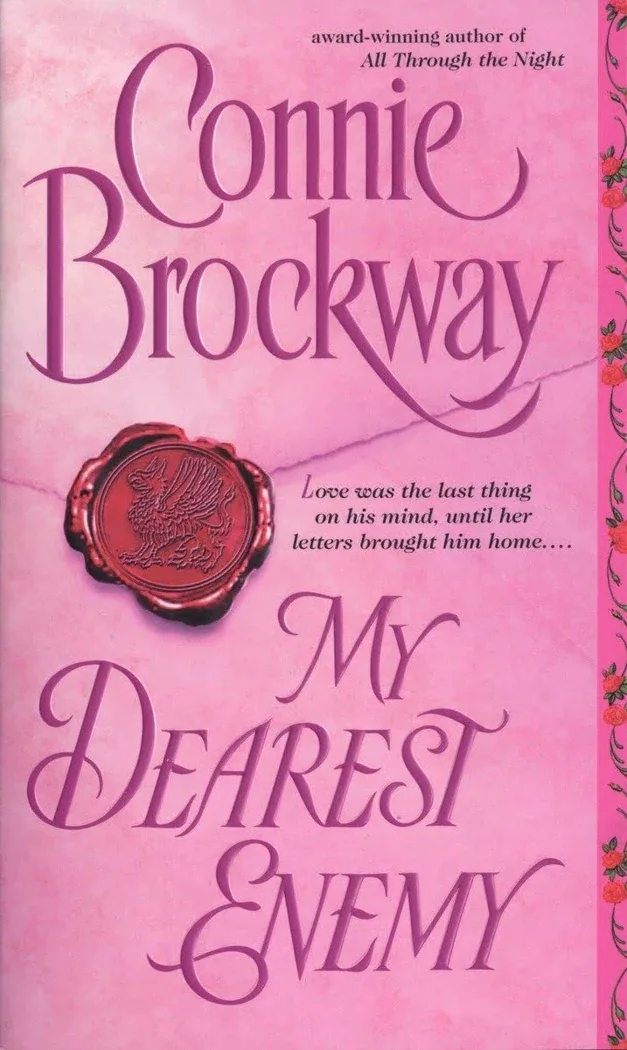
My Dearest Enemy at a Glance
My Dearest Enemy is Connie Brockway's 1998 Victorian historical romance, published by Dell and winner of the 1999 RITA Award for Long Historical Romance. It is a standalone. Lily Bede and Avery Thorne fight over an inheritance by letter for five years before they meet properly, and the book ends with a happily ever after. The paperback runs 384 pages.
| Author | Connie Brockway |
|---|---|
| Series | Standalone |
| Subgenre | Historical romance (Victorian England) |
| Main tropes | Enemies to lovers, romance in letters, contested inheritance, suffragette heroine, slow burn |
| Spice level | 3/5: Moderate, some open door |
| Content warnings | Prejudice about gender and illegitimacy, parental loss, a mother separated from her children (full list below) |
| POV | Third person, Lily and Avery |
| Ending | HEA, with an epilogue set years later |
| Pages | 384 (mass market paperback) |
| Audiobook | No audiobook edition |
| First published | July 1998 |
| Publisher | Dell (ebook reissue 2010) |
What Is My Dearest Enemy About?
My Dearest Enemy begins with a will. Horatio Thorne leaves his estate, Mill House, to Lily Bede, a sharp young suffragette with no fortune of her own. The terms are strict: she must manage the place for five years and make it pay. If she fails, it goes to his heir, Avery Thorne, the nephew Horatio considered a sickly wastrel.
Avery, who has spent years adventuring abroad, had expected the house and the care of his young nephew Bernard. Instead he gets Lily, and the two are obliged to correspond about the estate. The letters start out as insults. Over five years they become something else, and then Avery comes home, changed, and the woman who knows him best on paper has to decide whether to trust the man in person.
What Makes This Enemies to Lovers Romance Work
My Dearest Enemy works because the enemies part is funny and the lovers part is earned. Lily and Avery have a genuine conflict of interest: her success means his loss. That gives every letter an edge, and the slow drift from barbs to confidences feels like two people discovering each other against their own plans.
The second hook is Lily. She is a suffragette who believes what she says, and Publishers Weekly praised the way the book handles social questions without preaching. She is also illegitimate, and the prejudice she has lived with shapes every choice she makes about Avery.
And there is Avery himself, a hero Caz Owens at All About Romance described as more beta than alpha, who treats Lily as an equal. If you love enemies to lovers where the respect is as strong as the heat, this book is a touchstone.
My Review
I first read My Dearest Enemy for the letters, which I had heard about for years, and I was braced for a gimmick. It is not one. The correspondence is the spine of the book, and Connie Brockway uses it to make a five-year courtship feel like it actually took five years. When the leads finally share a room, they already know each other, and the book has the confidence to let that knowledge show.
Romance and Chemistry
The romance is a long, slow burn, and the yearning is the point. An All About Romance reviewer, writing in 2003, gave the book desert island keeper status and singled out the yearning between the leads, including a confession from Avery about what one kiss did to him. That moment is worth the price of the book. The same reviewer wished there were even more letters, and I understand why: they are some of the best writing in it.
Once Avery is home, the chemistry moves off the page and into the house, and it stays charged. Their arguments are still arguments. Caz Owens praised the witty, sarcastic banter between them, and I would add that the banter never covers for a lack of feeling. You always know what each of them wants and is afraid to say.
The Characters
Lily is a heroine of conviction, and the book takes her politics seriously. She hires the women nobody else will, she argues for votes and property, and she distrusts men for reasons the plot makes concrete. Caz Owens praised the handling of her struggles with gender and illegitimacy. My one complaint is shared by Caz: Lily's loyalty to her mother's grievances keeps her from seeing Avery clearly for longer than I wanted.
Avery is lovely. He is honorable without being stiff, and his feeling for young Bernard is one of the book's quiet pleasures; Caz called that relationship just lovely, and it is. The 2003 All About Romance review noted the book's theme that a man's honor, not his clothes or manners, is what defines him, and Avery embodies it without ever announcing it. The secondary cast, especially Bernard and Francesca, earns its space.
Writing and Pacing
Brockway's prose is witty and warm, with a narrator who enjoys her characters. Publishers Weekly praised the mix of passion, humor and emotional depth, and the tone is lighter than her darker earlier novel All Through the Night, which PW also noted.
The weak point is the ending. After so much slow, careful building, the main conflict resolves quickly, and Caz Owens called the ending very abrupt and a little anticlimactic. An epilogue then jumps roughly a decade ahead. I enjoyed the glimpse, but I would have traded it for another chapter in the present.
My Dearest Enemy is a witty, deeply felt Victorian courtship told largely through letters, with a heroine of real conviction and an ending that comes too fast. Read it if you love slow-burn enemies to lovers; go in knowing the finale is the briefest part.
How Spicy Is My Dearest Enemy?
My Dearest Enemy is a 3 out of 5 on our scale: Moderate, some open door. The tension builds for most of the book, much of it through the letters, and there are on-page love scenes once Lily and Avery are together, but they are few. The 2003 All About Romance reviewer thought the story could have used at least one more.
The love scenes are consensual and grounded in the emotional arc rather than added for heat. Our heat levels guide explains the full scale.
Content warnings, drawn from reader reports and our own read:
- Prejudice against women and against illegitimate children, in period voice
- Parental loss and grief
- A mother's separation from her children in the heroine's family history
- Childhood illness (asthma) in the hero's past
- Unmarried, pregnant servants and the social stigma they face
- On-page sexual content
Our content warnings guide explains how we compile these lists.
Who Should Read My Dearest Enemy?
My Dearest Enemy suits readers who want a witty, slow-burn enemies to lovers Victorian romance with a political heroine, a gentle hero and moderate heat. It is less suited to readers who want a lot of love scenes or a long, satisfying finale.
Best for:
- Fans of letters, epistolary romance and long-distance courtships
- Readers who love slow burn with real yearning
- Anyone who wants a suffragette or politically engaged heroine
- Readers working through award-winning classics of historical romance
Not for:
- Readers who want frequent, explicit scenes (try our spicy picks)
- Anyone who needs a slow, fully worked-out ending
- Readers who dislike heroines who hold onto a grudge
- Anyone wanting an alpha hero who takes charge
What Readers and Critics Are Saying
My Dearest Enemy is one of the most honored historicals of the late 1990s. It won the 1999 RITA Award for Long Historical Romance from Romance Writers of America, and Publishers Weekly gave it a warm trade review in 1998, calling it a Victorian romance for mature readers and praising its witty, honorable hero.
Where they agree. The letters and the yearning. The 2003 All About Romance review named it one of the reviewer's top ten romances, and Caz Owens, revisiting it for All About Romance in 2017, graded it a B plus and praised the letter format, the banter and the secondary cast.
Where they split. Lily's stubbornness and the ending. Caz Owens thought Lily's fixation on her mother's grievances kept the couple apart too long and that the finale was abrupt, and commenters on her review agreed about the brevity. Some readers find touches such as Lily's household of pregnant servants a little cute. Others, including commenters who rate it A minus, simply reread it.
The Eikna Evidence Scorecard
My Dearest Enemy scores 8.5 out of 10 on the Eikna Evidence Scorecard, with high marks for romance, characters, writing and reread appeal, held back by a compressed ending and modest heat.
| Dimension | Score (/5) | Why |
|---|---|---|
| Romance (20%) | 4.5 | The letters build real yearning, praised by both All About Romance reviews. |
| Characters (15%) | 4.5 | A principled heroine and an honorable beta hero, per Caz Owens. |
| Writing and pacing (15%) | 4.5 | Witty, warm prose; Publishers Weekly praised its humor and depth. |
| Emotional impact (15%) | 4.5 | The confessions and family moments land hard near the end. |
| Heat level (10%) | 3.5 | Few love scenes; one reviewer wanted at least one more. |
| Ending satisfaction (15%) | 3.5 | An HEA, but Caz Owens found the finale very abrupt. |
| Reread appeal (10%) | 4.5 | A RITA winner readers keep rereading, per All About Romance. |
The Eikna Overall Ranking: My Dearest Enemy is Connie Brockway's best-known single title and one of the standout Victorian romances of the 1990s, with a final Eikna Score of 8.5/10.
Is My Dearest Enemy a Standalone?
My Dearest Enemy is a standalone. It is not part of a series, it follows one couple from start to finish, and you need nothing else by Connie Brockway to read it. It came between All Through the Night (1997) and The Passionate One (1999) in her bibliography.
If you want more Brockway afterward, her other historicals include:
- As You Desire (1997)
- All Through the Night (1997)
- My Dearest Enemy (1998)
- The Bridal Season (2001)
- The Lady Most Likely... (2010, with Julia Quinn and Eloisa James)
Best format: print or ebook, so you can linger over the letters. Our series order guide covers connected historicals if you want a longer run.
If You Loved My Dearest Enemy, Read These Next
If you loved My Dearest Enemy, look for historical romances with sparring couples, clever heroines and heroes who prove themselves through decency rather than swagger.
- Lord of Scoundrels by Loretta Chase: the other great 1990s sparring match, funnier and more combative.
- Lord Perfect by Loretta Chase: a proper hero and an improper heroine thrown together on a chase.
- The Luckiest Lady in London by Sherry Thomas: a marriage that begins in mistrust and turns into a slow emotional reckoning.
- Slightly Dangerous by Mary Balogh: a cool, proud hero undone by a woman who refuses to be impressed.
- The Viscount Who Loved Me by Julia Quinn: enemies to lovers with banter and a hero hiding fear under arrogance.
Frequently Asked Questions
My Dearest Enemy raises the same questions from most readers: how spicy it is, whether it stands alone, how it ends and why it is so well regarded. Short answers below.
Is My Dearest Enemy spicy?
Moderately. My Dearest Enemy is a 3 out of 5 on our scale, with long-building tension and a small number of open-door love scenes.
Is My Dearest Enemy a standalone?
Yes. My Dearest Enemy is a standalone novel with one couple and a complete story.
Does My Dearest Enemy have a happy ending?
Yes. Lily and Avery get a happily ever after, followed by an epilogue set about a decade later.
Is My Dearest Enemy told in letters?
Partly. Letters between Lily and Avery carry the first stretch of the courtship, and the rest of the book follows them in person.
Did My Dearest Enemy win any awards?
Yes. My Dearest Enemy won the 1999 RITA Award for Long Historical Romance from Romance Writers of America.
Is there a My Dearest Enemy audiobook?
Not that we know of. Connie Brockway's My Dearest Enemy is sold in paperback and ebook, and the Audible title of the same name is a different novel.
The Bottom Line
My Dearest Enemy earns an 8.5/10 and a Highly recommended badge. It is for readers who want a witty, slow-burn Victorian romance where two rivals fall in love through letters, with a suffragette heroine and a quietly decent hero, and who can live with an ending that wraps up faster than it should. The reason to pick it up is the correspondence: few romances make the written word this romantic.
Buy on Amazon Buy at Bookshop.org
Some links on this page are affiliate links: Eikna Romance may earn a small commission at no extra cost to you.
Sources
- Connie Brockway, Wikipedia (1999 RITA Award, bibliography)
- My Dearest Enemy, Romance Wiki (University of Birmingham)
- My Dearest Enemy, Publishers Weekly
- My Dearest Enemy, Penguin Random House (editions)
- My Dearest Enemy, All About Romance (2003 review)
- My Dearest Enemy by Connie Brockway, All About Romance (Caz Owens)
- My Dearest Enemy, Fantastic Fiction
Audible lists a different novel with the same title; no audiobook of the Brockway book was found.
How we review: every Eikna score is built from a seven-part evidence scorecard. Read our methodology.