The Lady Tempts an Heir by Harper St. George Review
Eikna Score: 7.8/10. Recommended.
The Lady Tempts an Heir is a warm fake engagement romance with two adults who want the same kind of useful life, and its frank handling of infertility gives it more weight than most Gilded Age romps. The secret at its center drags in the middle, and a time skip cuts away from the best stretch of the courtship.
Read it if you like historical heroes who back the heroine's work instead of rescuing her, or you want a romance that treats infertility as a real subject. Skip it if one long-withheld secret tests your patience, or you need every period detail of a business plot to hold up.

The Lady Tempts an Heir at a Glance
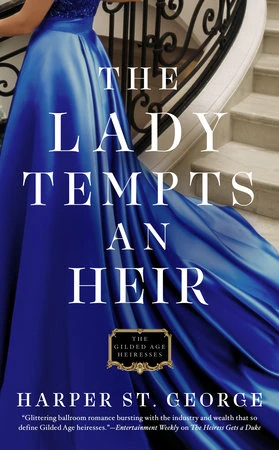
The Lady Tempts an Heir is the third book in Harper St. George's Gilded Age Heiresses series, published by Berkley in February 2022. It is a fake engagement historical romance set in Victorian London, pairing an American heir with an English widow who runs a charity, with open-door scenes and a happily ever after.
| Author | Harper St. George |
|---|---|
| Series | The Gilded Age Heiresses, book 3 of 4 (each book stars a new couple) |
| Subgenre | Historical romance (Victorian London, Gilded Age Americans) |
| Main tropes | Fake engagement, widowed heroine, American heir, shared ambitions, a secret that blocks marriage |
| Spice level | 3/5: Moderate, some open door |
| Content warnings | Infertility, a recalled sexual assault by a late husband, a husband's death from illness (off page), class prejudice (full list below) |
| POV | Dual (Max and Helena) |
| Ending | HEA |
| Pages | 336 (mass market paperback) |
| Audiobook | Narrated by Justine Eyre, about 10 hours (Tantor Audio) |
| First published | February 22, 2022 |
| Publisher | Berkley |
What Is The Lady Tempts an Heir About?
The Lady Tempts an Heir follows Maxwell Crenshaw, the blunt American heir to his family's business, who arrives in London under pressure from his father to settle his future the way his father wants. Lady Helena March is a young widow with no intention of marrying again. She is building a home for young women in London, and her plans are short of money and one scandal away from collapse.
A fake engagement solves both problems. Max gets out from under an unwanted match, and Helena gets the cover and support her charity needs. The arrangement has rules, and both of them keep breaking them. Helena also has a private reason she believes she can never be anyone's wife again.
What Makes This Fake Engagement Romance Work
The Lady Tempts an Heir works because the fake engagement is a business deal between two people who respect each other's business. Max needs a buffer against his father; Helena needs money and a respectable name attached to her project. Neither is doing the other a favor, and Publishers Weekly put its finger on the appeal when it praised the way the couple's ambitions line up.
That shared purpose changes the usual shape of the trope. In plenty of fake dating books the fun is two people pretending to like each other. Here they like each other almost at once, and the pretending is about something else: pretending the engagement is temporary, and pretending that Helena's reason for refusing marriage does not exist.
The Romance Dish liked that both leads go into the arrangement as equals, and I think that is the hook. Max is not a duke swooping in. He is a rough-edged American who would rather fund a shelter than attend a ball, and he is happy to let Helena run the shelter. If you like the fake dating trope best when the rules are a cover for real partnership, this one delivers.
My Review
I went into The Lady Tempts an Heir expecting a pleasant third book in a series I had enjoyed, the kind you read for the family cameos. It turned out to be the most adult of the Crenshaw books so far. Not because of the spice, which is moderate, but because both leads arrive with history and the book lets that history matter.
Helena's first marriage was not happy, and it left her with a fact she has organized her whole life around: she cannot have children. St. George puts that on the table early for the reader, if not for Max, and then spends the book on what it means for a woman in her position. Library Journal singled out how openly the book discusses infertility, and Jana and Books said the author approached it with empathy. I agree with both. It never becomes a lecture, and it never becomes a plot device to be fixed in the last chapter.
Romance and Chemistry
The chemistry is good and it starts early. Max and Helena argue well, and they agree on the things that matter (who deserves help, what money is for) while disagreeing on nearly everything else. The Romance Dish wrote that the two of them "set off enough sparks to start a forest fire," which is a little generous, but I understand the impulse. Their quieter scenes are better than their heated ones.
My biggest frustration matches Lady Geeks Media's. There is a stretch where Max and Helena travel together, alone and in close quarters, and it is building into the best part of the book. Then the story jumps forward and skips most of it. I wanted those days on the page. The romance still lands, but it lands with a gap where its strongest forced proximity material should have been.
The other drag is the secret. Publishers Weekly found the infertility storyline slow in places, and I felt the same. Max wants a family, Helena knows she cannot give him one the usual way, and for a long middle section she will not say so. Her reasons are sound and painful. The repetition is still repetition.
The Characters
Helena is the reason I would recommend this book. She is stubborn, practical and a bit rigid, and the book does not ask her to soften so much as to let someone else carry part of the weight. Her charity is not decoration. She has opinions about how it should run, and she is right about most of them.
Max is a likable kind of hero I wish historicals used more. He is protective of his sisters, unimpressed by English rank and willing to change his mind. Smexy Books described him as rougher than the usual English lord, and that roughness is a selling point. Lady Geeks Media pointed out that he is quick to tell Helena her infertility is not her fault, and the book gives him several moments like that which feel earned rather than scripted.
The Crenshaw sisters drift through, and series readers will enjoy seeing August and Violet again. Camille is clearly being set up for the next book. Max's father is more pressure than person, which is fine for the role he plays.
Writing and Pacing
St. George writes clean, readable prose with a good ear for an argument. The first third moves quickly, because the arrangement gives every scene a purpose. The middle sags under the secret, and the time skip makes the pacing feel uneven: slow where the plot repeats, rushed where the relationship should have had room.
The business plot is the weakest strand. A StoryGraph reviewer, mari_books, questioned the business details, and I did not find them very convincing either. They mostly exist to give Max something to prove. Readers who want a meticulous Victorian business story will be underfed; readers who want the romance will not mind much.
The Lady Tempts an Heir is a kind, grown-up fake engagement romance that takes infertility seriously and gives its heroine real work to do. Read it if you want partnership over rescue and can live with a secret that outstays its welcome.
How Spicy Is The Lady Tempts an Heir?
The Lady Tempts an Heir is a 3 out of 5 on our scale: Moderate, some open door. Smexy Books confirms the intimate scenes between Max and Helena are on the page and steamy, though the same reviewer wished they ran longer. Jana and Books describes the series overall as short, spicy reads.
The heat builds after the engagement is underway, and the scenes are about trust as much as desire, given Helena's history. If you want to compare it with other books, our romance heat levels guide explains the full scale, and our spicy romance list has hotter options.
Content warnings, drawn from reviews by Smexy Books and StoryGraph readers:
- Infertility as a central theme
- Open-door sexual content
- Recollection of sexual assault by the heroine's late husband
- Death of a spouse from illness (in the past, off page)
- Unmarried mothers and "fallen women" in a charity setting
- Class prejudice and family pressure to marry
Our content warnings guide explains how we compile these lists.
Who Should Read The Lady Tempts an Heir?
The Lady Tempts an Heir suits readers who like historical romance with working heroines, supportive heroes and a serious emotional issue handled with care. It is less suited to readers who want a fast, secret-free plot or a heavily researched business storyline, and it reads best if you already know the Crenshaw family.
Best for:
- Readers who want infertility represented honestly in romance
- Fans of fake engagements where the partnership is real from the start
- Anyone who likes a blunt American hero loose in London society
- Series readers who want more of the Crenshaw sisters
Not for:
- Readers who dislike a heroine keeping a major secret for most of the book
- Anyone looking for closed-door historical romance (see our closed door picks)
- Readers who want detailed, plausible period business plots
- Those who find recalled sexual trauma hard to read, even briefly
What Readers and Critics Are Saying
The Lady Tempts an Heir was well received by trade reviewers and romance blogs. Library Journal said it "hits all the right notes," Publishers Weekly praised the couple's devotion, Smexy Books gave it an A, and both The Romance Dish and Lady Geeks Media rated it 4.5 stars.
Where they agree. Nearly everyone singles out the couple's shared values. Publishers Weekly liked their aligned ambitions, The Romance Dish liked that they enter the arrangement as equals, and a StoryGraph reader, eawells, valued the respect and support between them. The infertility storyline also gets consistent credit: Library Journal called it notable, Jana and Books called the handling empathetic, and both Smexy Books and The Romance Dish praised a resolution that avoids an easy fix.
Where they split. Publishers Weekly found the concealed obstacle prolonged. Lady Geeks Media wanted more of the couple's journey together. On StoryGraph, mari_books questioned the business detail and some of Helena's narration, roget was less convinced by some of the descriptions of attraction, and yourbookishbff found the opening slow and flagged a remembered sexual encounter from Helena's marriage as distressing, while still praising the later chemistry.
The Eikna Evidence Scorecard
The Lady Tempts an Heir scores 7.8 out of 10 on the Eikna Evidence Scorecard. It earns its best marks for emotional impact, where the infertility storyline carries real weight, and its lowest for reread appeal, because the long-held secret and a skipped stretch of courtship are less rewarding a second time.
| Dimension | Score (/5) | Why |
|---|---|---|
| Romance (20%) | 4 | Equal partners with real chemistry, per The Romance Dish; Lady Geeks Media notes a time skip that cuts their best stretch. |
| Characters (15%) | 4 | Helena's work and Max's supportiveness stand out, per Smexy Books and Lady Geeks Media. |
| Writing and pacing (15%) | 3.5 | Readable prose; Publishers Weekly finds the concealed obstacle prolonged. |
| Emotional impact (15%) | 4.5 | Library Journal and Jana and Books both credit the open, empathetic handling of infertility. |
| Heat level (10%) | 4 | Open-door scenes as promised; Smexy Books calls them steamy but wanted them longer. |
| Ending satisfaction (15%) | 4 | A believable resolution without an easy fix, per The Romance Dish and Smexy Books. |
| Reread appeal (10%) | 3 | The secret and the business plot drag on a second read, as mari_books and Publishers Weekly note. |
The Eikna Overall Ranking: The Lady Tempts an Heir is the most emotionally serious entry in the Gilded Age Heiresses series and a solid mid-list Victorian romance, landing at a final Eikna Score of 7.8/10.
The Gilded Age Heiresses Reading Order
The Lady Tempts an Heir is book 3 of the four-book Gilded Age Heiresses series. Each book follows a new couple, so it can be read alone, but the Crenshaw family runs through all four, and Jana and Books recommends starting with book 1 for the full picture.
- The Heiress Gets a Duke: August Crenshaw's story
- The Devil and the Heiress: Violet Crenshaw's story
- The Lady Tempts an Heir (2022): Max Crenshaw and Helena March
- The Duchess Takes a Husband: Camille's story
Best format: print or ebook is fine, but Jana and Books called Justine Eyre's audiobook narration very well done, and it is a good way to hear the American and English voices play off each other. Our series order guide covers more connected romances.
If You Loved The Lady Tempts an Heir, Read These Next
If you loved The Lady Tempts an Heir, look for Victorian and Regency romances where the heroine has a cause, the hero supports it, and an arrangement or class gap gives the story its structure. These are the closest matches we have reviewed.
- The Devil and the Heiress by Harper St. George: the previous Crenshaw book, with more scheming and the same family warmth.
- The Siren of Sussex by Mimi Matthews: a gentler Victorian romance built on a working partnership, with dressmaking at its center and far less heat.
- Bringing Down the Duke by Evie Dunmore: a politically minded heroine and a hero on the other side of her cause.
- The Duchess Deal by Tessa Dare: a practical marriage arrangement with a seamstress heroine and more comedy.
- My Fake Rake by Eva Leigh: another historical fake courtship, lighter and sillier in tone.
Frequently Asked Questions
Readers usually ask the same things about The Lady Tempts an Heir: how spicy it is, whether it stands alone, how it ends and where it sits in the series. Short answers are below.
Is The Lady Tempts an Heir spicy?
Yes, moderately. The Lady Tempts an Heir is a 3 out of 5 on our scale, with open-door scenes that reviewers describe as steamy but not long.
Is The Lady Tempts an Heir a standalone?
It can be read alone. It is book 3 of the Gilded Age Heiresses series, and each book has a new couple, but the Crenshaw family appears throughout.
Does The Lady Tempts an Heir have a happy ending?
Yes. Max and Helena get a happily ever after.
Does The Lady Tempts an Heir deal with infertility?
Yes. Helena cannot have children, and the book treats this as a central, serious theme rather than a problem to be solved by a surprise.
Is there a The Lady Tempts an Heir audiobook?
Yes. The audiobook is narrated by Justine Eyre and runs about 10 hours, published by Tantor Audio.
What order should I read the Gilded Age Heiresses series in?
Read The Heiress Gets a Duke, The Devil and the Heiress, The Lady Tempts an Heir, then The Duchess Takes a Husband.
What age is The Lady Tempts an Heir appropriate for?
The Lady Tempts an Heir is an adult romance with open-door sexual content and a recalled sexual assault, so we recommend it for adult readers.
The Bottom Line
The Lady Tempts an Heir earns a 7.8/10 and a Recommended badge. It is for historical romance readers who want a fake engagement between two capable adults, a hero who backs the heroine's work, and a story that faces infertility directly. The one reason to read it is Helena, whose stubbornness the book respects; go in ready for a slow middle.
Buy on Amazon Buy at Bookshop.org Listen on Audible Listen on Libro.fm
Some links on this page are affiliate links: Eikna Romance may earn a small commission at no extra cost to you.
Sources
- The Lady Tempts an Heir, Penguin Random House (publisher listing and praise)
- The Lady Tempts an Heir, Publishers Weekly review
- The Lady Tempts an Heir, Library Journal review
- Review: The Lady Tempts an Heir, Smexy Books
- Review: The Lady Tempts an Heir, The Romance Dish
- The Lady Tempts an Heir review, Lady Geeks Media
- Historical romance review: The Lady Tempts an Heir, Jana and Books
- StoryGraph review by eawells
- StoryGraph review by roget
- StoryGraph review by mari_books
- StoryGraph review by yourbookishbff
- The Lady Tempts an Heir audiobook, Tantor Audio
How we review: every Eikna score is built from a seven-part evidence scorecard. Read our methodology.