The Kiss Quotient by Helen Hoang Review
Eikna Score: 8.3/10. Recommended.
The Kiss Quotient is a warm, funny and properly steamy debut that gives its autistic heroine a full inner life instead of a diagnosis to manage. The lesson plan premise is a gift, but a repetitive misunderstanding and one consent moment that has not aged well keep it just short of the top shelf.
Read it if you want a gender-flipped Pretty Woman with real tenderness, or you like open-door romance where the sex scenes move the relationship forward. Skip it if you have no patience for two leads who each assume the other is not invested, or you need every intimate scene built on explicit verbal consent.

The Kiss Quotient at a Glance
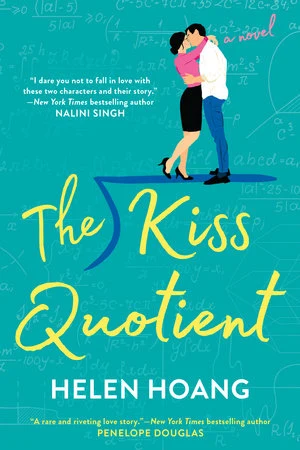
The Kiss Quotient is Helen Hoang's 2018 debut and the first book in her Kiss Quotient series: an open-door contemporary romance about an autistic econometrician who hires an escort for intimacy lessons. It runs 352 pages in paperback, alternates between both leads in third person, and ends with a happily ever after.
| Author | Helen Hoang |
|---|---|
| Series | The Kiss Quotient series, book 1 (each book stars a new couple) |
| Subgenre | Contemporary romance |
| Main tropes | Paid arrangement, intimacy lessons, opposites attract, neurodivergent heroine, secret family burden |
| Spice level | 4/5: Steamy, multiple explicit scenes |
| Content warnings | Sex work, internalized ableism, a parent who abandoned his family, parental cancer, a pushy kiss (full list below) |
| POV | Dual, third person (Stella and Michael) |
| Ending | HEA |
| Pages | 352 (paperback); 336 (ebook) |
| Audiobook | Narrated by Carly Robins, 9 hours 36 minutes (Dreamscape Media) |
| First published | June 5, 2018 |
| Publisher | Berkley |
What Is The Kiss Quotient About?
The Kiss Quotient follows Stella Lane, a thirty-year-old econometrician in the Bay Area tech world who builds the algorithms that predict what customers will buy next. She is wealthy, brilliant at her job and short on romantic experience. Stella has Asperger's, and kissing, so far, has felt like an unpleasant chore.
Her solution is very Stella: if she is bad at something, she practices. She hires Michael Phan, a half Vietnamese, half Swedish escort, and hands him a structured list of lessons. Michael cannot afford to turn her offer down. What starts as a practice arrangement turns into a full-time practice relationship, and it starts to cost both of them more than money.
What Makes This Paid Arrangement Romance Work
The Kiss Quotient works because its paid arrangement is a mirror held up to both leads at once. Stella believes she is fundamentally unlovable as she is, and Michael believes he is worth only what someone pays for him. A transaction is the only kind of closeness either of them thinks they deserve.
Helen Hoang has said she wanted to write Pretty Woman with the roles reversed: the rich woman hires the man. That swap does a lot of quiet work. Michael is the one keeping a secret from his family (he took up escorting to cover his mother's cancer treatment, a setup established early), and Stella is the one with the money and the spreadsheet. Nobody here is rescuing anybody.
The other draw is the lesson structure itself. Every session has a stated goal, which lets the book track the moment each goal stops mattering. Readers who like arrangement romances in the fake dating family, where the rules are the point and breaking them is the payoff, will find the escalation unusually readable. You always know what Stella thinks the next lesson is for. You usually know before she does that it is for something else.
My Review
I came back to The Kiss Quotient expecting the premise to carry it, the way a good hook carries a lot of contemporary romance for the first hundred pages and then runs out of road. That is not what happened. The premise is fun, but what kept me reading was how carefully Hoang builds Stella's head from the inside: her routines, her literal reading of other people, the price a social evening extracts from her.
Hoang was diagnosed as autistic while she was writing the book, after her daughter's teacher suggested testing and Hoang started reading about how autism presents in women. You can feel that the book is partly a working-through. Stella's sensory limits are never comic and never a puzzle for Michael to solve. Publishers Weekly put it well when it praised Hoang for "never reducing her to a walking diagnosis," and I agree with that more on a reread than I did the first time.
Romance and Chemistry
The chemistry is the book's strongest asset, and it comes from attention more than heat. Michael notices things. He learns what overwhelms Stella and what settles her, and he adjusts without making her explain herself twice. The sex scenes are steamy, but the moments I remembered afterwards were smaller: Stella being folded into Michael's loud family, and discovering she does not have to perform for them.
That said, the middle third leans hard on one engine. Stella assumes Michael is only there for the paycheck; Michael assumes Stella will move on to someone with a degree and a better family. Both are wrong, both chapters tell us so, and the dual third-person POV means the reader is always a step ahead of the couple. Literary Elephant found that repetition frustrating, and I partly agree. A couple of beats land twice.
The harder issue is consent. There is a kiss where Stella says she does not want to be kissed, and Michael presses because, he says, he needs it. She gives in for his sake rather than her own, and the story does not treat that as a problem. Literary Elephant called it the most troubling moment in the novel, and reading it in 2026, I can see why. It is not the whole book, and Michael is otherwise patient and careful. But it is on the page, and you should know it is there.
The Characters
Stella is the reason to read this. She is very good at her job, blunt in meetings, anxious at parties and much braver than she believes. Her arc is not about becoming less autistic. It is about deciding she is allowed to want something without first fixing herself. Kirkus noted that her difference is met with unconditional acceptance by Michael, and that is right: he never asks her to change, only to stop apologising.
Michael is more conventional on paper (the gorgeous escort with a heart of gold), but Hoang gives him a real wound. His father cheated on and abandoned the family, and Michael's terror is that he is the same kind of man underneath. That fear drives most of his bad decisions. It also gives him a lot to lose, which matters in a story that could have been weightless.
The supporting cast is where the book feels most alive. Michael's mother and his sisters are loud, nosy and very funny, and Library Journal singled out the women in his family as scene stealers. I would not argue. Stella's own parents are thinner, sketched mainly as people who love her and worry about her.
Writing and Pacing
Hoang's prose is clean and quick. She does not over-describe and she is good at a dry line of dialogue. The book moves fast through the first half because each lesson is its own small set piece. It slows in the back half, where the misunderstanding has to stretch, and there is a late plot turn that Kirkus called contrived and out of place. I thought the same: it raises the stakes in a way the story did not need.
The jobs are mostly scenery. Stella's work gets a few good scenes, and Michael's talent as a fashion designer is real but secondary. That is a normal romance trade, and I did not mind, though readers who want a workplace novel should look elsewhere.
The Kiss Quotient is a generous, sexy debut with a heroine I will remember, held back by a stretched misunderstanding and one kiss I wish had been written differently. Read it if the premise appeals and you can take its 2018 blind spots with open eyes.
How Spicy Is The Kiss Quotient?
The Kiss Quotient is a 4 out of 5 on our scale: Steamy, multiple explicit scenes. The sex is open door and frequent, because the lessons are the plot. Literary Elephant described the scenes as sensual and frank without being overly graphic, which matches my read. They are explicit, but written for feeling rather than choreography.
Consent is mostly careful and talked through, with the exception of the kiss discussed above. If you want to see where this sits against other books, our romance heat levels guide explains the full scale, and our spicy romance list has more in this range.
Content warnings, drawn from the book, the Trigger Warning Database and reader reports:
- On-page explicit sexual content
- Sex work as a central theme
- Internalized ableism and ableist comments
- A father who abandoned his family; references to infidelity
- A parent with cancer (treatment, not death)
- Anxiety and social overwhelm
- A kiss pursued after the heroine says no to it
- Recounted references to past sexual assault
- Prolonged miscommunication between the leads
Our content warnings guide explains how we compile these lists.
Who Should Read The Kiss Quotient?
The Kiss Quotient suits readers who want a steamy contemporary romance with a neurodivergent heroine written from the inside, a hero with family obligations, and a big, loving supporting cast. It is less suited to readers who dislike miscommunication plots or who read romance for a hero who never pushes past a no.
Best for:
- Readers looking for autistic representation by an autistic author
- Fans of open-door romance where intimacy drives character growth
- Anyone who liked the Pretty Woman setup and wanted the roles reversed
- Readers who love a hero's noisy, meddling family
Not for:
- Readers who need closed-door or low-heat romance (try our closed door picks)
- Anyone who finds "each thinks the other doesn't care" plots exhausting
- Readers for whom any blurred consent on the page is a dealbreaker
- People wanting a workplace story with real detail about the jobs
What Readers and Critics Are Saying
Critics were warm on The Kiss Quotient from the start. Publishers Weekly called it an excellent debut, Library Journal gave it a starred review, The New York Times Book Review praised Hoang for writing Stella with insight and empathy, and the New York Public Library named it one of its Best Books of 2018.
Where they agree. Almost everyone singles out Stella. Kirkus praised the character work and the couple's insecurities, People and BuzzFeed both praised the writing, and Roxane Gay called it fun, original, sexy and sensitive. Literary Treats picked out the family characterisation and found the insecurities made the conflict understandable.
Where they split. The misunderstanding is the most common complaint: Literary Elephant gave the book three stars and found the repeated assumptions tiring. The same review raised the consent concerns covered above. Kirkus, otherwise positive, thought a late plot development was unnecessary. And autism representation, the book's selling point, is not settled. On Reddit's r/RomanceBooks, at least one autistic reader described the portrayal as infantilising, while other readers, including an Apple Books listener, said they recognised themselves in Stella. Both responses are real; neither is a consensus.
The book's commercial life tells its own story. Wikipedia notes an initial print run of 100,000 copies and a fourth printing within weeks of release, and the film and TV rights were optioned in 2018.
The Eikna Evidence Scorecard
The Kiss Quotient scores 8.3 out of 10 on the Eikna Evidence Scorecard, with its highest marks for romance, characters and heat, and its lowest for the ending, where a stretched misunderstanding and a late twist that Kirkus called contrived take some shine off a deserved HEA.
| Dimension | Score (/5) | Why |
|---|---|---|
| Romance (20%) | 4.5 | Lessons that turn into tenderness; Publishers Weekly praises the shift from transaction to attachment. |
| Characters (15%) | 4.5 | Stella is fully realised, per Publishers Weekly and The New York Times Book Review; Michael's family adds warmth. |
| Writing and pacing (15%) | 4 | Quick, funny prose; Literary Elephant notes the middle repeats itself. |
| Emotional impact (15%) | 4 | Library Journal points to emotional depth that lingers; some readers found the autism portrayal less convincing. |
| Heat level (10%) | 4.5 | Delivers the open-door intimacy the premise promises; Literary Elephant calls it frank but not overly graphic. |
| Ending satisfaction (15%) | 3.5 | A real HEA, but Kirkus calls the late plot development contrived. |
| Reread appeal (10%) | 4 | Stella and Michael's family hold up on a reread; the consent moment reads worse with time. |
The Eikna Overall Ranking: The Kiss Quotient is the hottest and most accessible book in Hoang's series, a notch below the emotional heft of The Heart Principle, and it lands at a final Eikna Score of 8.3/10.
The Kiss Quotient Series Reading Order
The Kiss Quotient is book 1 of a three-book series, but each novel follows a different couple and works as a standalone. Start with The Kiss Quotient if you want to meet Michael's extended family, since his cousins lead the next two books.
- The Kiss Quotient (2018): Stella and Michael
- The Bride Test (2019): Khai, Michael's autistic cousin, and Esme, who comes from Vietnam to meet him
- The Heart Principle (2021): Quan and Anna
Best format: print or ebook if you want to linger over the lesson structure, but Carly Robins' audiobook is a good option, and Library Journal's audio review commended her narration. Our series order guide covers other connected romances.
If You Loved The Kiss Quotient, Read These Next
If you loved The Kiss Quotient, the closest follow-ups are the rest of Hoang's series and other contemporary romances with neurodivergent leads, arrangement plots or accomplished heroines who doubt themselves in love.
- The Bride Test by Helen Hoang: the same family and the same care with autistic interiority, this time from the hero's side.
- Act Your Age, Eve Brown by Talia Hibbert: a funny, steamy contemporary with an autistic hero and a heroine who has never quite found her footing.
- The Love Hypothesis by Ali Hazelwood: another arrangement romance with a scientist heroine, built for a different purpose and with a lighter touch.
- Get a Life, Chloe Brown by Talia Hibbert: a heroine with a chronic illness, a literal list and a hero who learns to read her.
- Book Lovers by Emily Henry: for the accomplished woman who thinks she is the wrong shape for a romance.
Frequently Asked Questions
The Kiss Quotient raises the same handful of questions for most readers: how spicy it is, whether it stands alone, whether it ends happily and whether there is an audiobook or adaptation. Short answers below.
Is The Kiss Quotient spicy?
Yes. The Kiss Quotient is a 4 out of 5 on our scale, with multiple open-door, explicit sex scenes that are central to the intimacy lessons plot.
Is The Kiss Quotient a standalone?
Yes. It is book 1 of the Kiss Quotient series, but each book follows a different couple, so it can be read on its own.
Does The Kiss Quotient have a happy ending?
Yes. The Kiss Quotient ends with a happily ever after for Stella and Michael.
Is Stella autistic in The Kiss Quotient?
Yes. Stella has Asperger's, and Helen Hoang, who is autistic herself, was diagnosed while writing the book.
What age is The Kiss Quotient appropriate for?
The Kiss Quotient is an adult romance with explicit sexual content and sex work themes, so we recommend it for adult readers.
Is there a The Kiss Quotient audiobook?
Yes. The audiobook is narrated by Carly Robins and runs 9 hours 36 minutes, published by Dreamscape Media.
Is The Kiss Quotient being made into a movie?
The film and TV rights were optioned in 2018, but no film or series has been released and no cast has been announced.
What order should I read the Kiss Quotient series in?
Read The Kiss Quotient, then The Bride Test, then The Heart Principle. Each has a new couple, so publication order is a preference, not a requirement.
The Bottom Line
The Kiss Quotient earns an 8.3/10 and a Recommended badge from us. It is for readers who want a steamy, funny contemporary romance with an autistic heroine who is allowed to be the smartest person in the room and still unsure in love. The one reason to pick it up is Stella herself; go in knowing about the misunderstanding and that one kiss, and she is worth the trip.
Buy on Amazon Buy at Bookshop.org Listen on Audible Listen on Libro.fm
Some links on this page are affiliate links: Eikna Romance may earn a small commission at no extra cost to you.
Sources
- The Kiss Quotient, Penguin Random House (publisher listing and praise)
- The Kiss Quotient, Publishers Weekly review
- The Kiss Quotient, Kirkus Reviews
- So Much Love: Helen Hoang's The Kiss Quotient, Kirkus interview
- The Kiss Quotient, Library Journal audiobook review
- The Kiss Quotient, Wikipedia
- Helen Hoang interview, Refinery29
- Review: The Kiss Quotient, Literary Elephant
- Review: The Kiss Quotient, Literary Treats
- Autism representation in The Kiss Quotient, r/RomanceBooks
- The Kiss Quotient, Trigger Warning Database
- The Kiss Quotient audiobook, Libro.fm
- The Kiss Quotient audiobook, Apple Books
- The Kiss Quotient adaptation status, Movie Insider
How we review: every Eikna score is built from a seven-part evidence scorecard. Read our methodology.