Sylvester by Georgette Heyer Review
Eikna Score: 8.7/10. Highly recommended.
Sylvester is one of Georgette Heyer's sharpest Regency comedies: a proud, correct duke and a young woman who has secretly put him in a novel as its villain. The secondary farce runs long in France, but the bickering romance and the book's quiet point about kindness versus good manners still feel fresh.
Read it if you love sparring couples and witty dialogue, or you want a closed-door Regency classic with real bite. Skip it if you need on-page heat, or long comic set pieces with secondary characters test your patience.
Sylvester at a Glance
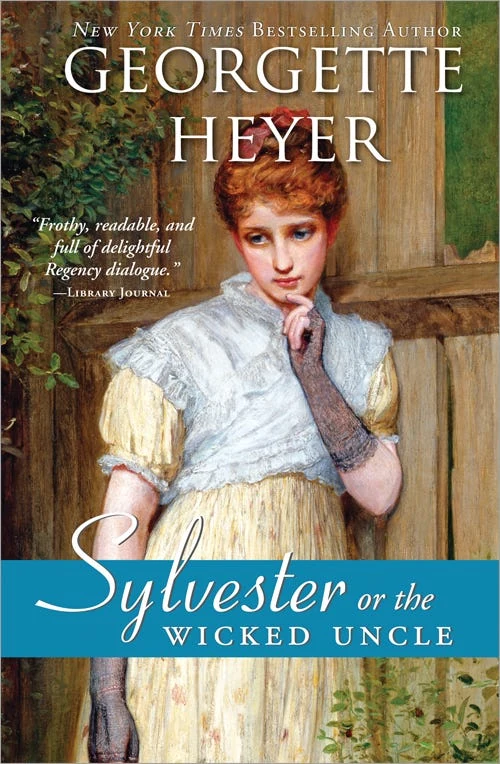
Sylvester, or the Wicked Uncle is a standalone Regency romance by Georgette Heyer, first published in 1957 by Heinemann in London and Putnam in New York. It pairs a proud duke with a young novelist who has satirised him, is closed door and ends happily.
| Author | Georgette Heyer |
|---|---|
| Series | Standalone |
| Subgenre | Historical romance (Regency, 1817 to 1818), romantic comedy |
| Main tropes | Bickering leads, proud hero humbled, author heroine, snowbound inn, chase across the Channel |
| Spice level | 1/5: Kisses only / closed door |
| Content warnings | Emotional and physical abuse of the heroine by her stepmother, bereavement, public humiliation (full list below) |
| POV | Third person, mostly following Phoebe and Sylvester |
| Ending | HEA |
| Pages | 400 (Sourcebooks Casablanca, 2011) |
| Audiobook | Narrated by Matt Addis, 12 hours 19 minutes (Penguin Audio, 2021); older recordings by Nicholas Rowe and, abridged, Richard Armitage |
| First published | 1957 |
| Publisher | Heinemann (UK) and Putnam (US); current US edition Sourcebooks Casablanca |
What Is Sylvester About?
Sylvester Rayne, Duke of Salford, has decided it is time to marry, and he approaches the business the way he approaches everything: correctly. One candidate is Phoebe Marlow, whose grandmother, Lady Ingham, has quietly suggested the match. Phoebe is nineteen, unhappy at home and not interested. She has also, in secret, written a novel, and its villain is closely modelled on Sylvester.
To avoid the match, Phoebe runs away with her childhood friend Tom Orde, heading for her grandmother in London. A carriage accident strands them at a wayside inn in the snow, and Sylvester turns up at the same inn. Then the novel is published, Sylvester recognises himself, and a farce involving his widowed sister-in-law, her foolish new husband and Sylvester's small nephew carries everyone off to France.
What Makes This Enemies to Lovers Romance Work
Sylvester works as an enemies to lovers romance because both leads have a point. Sylvester really is proud, and Phoebe's portrait of him as an arrogant aristocrat is not unfair. But Phoebe is quick to judge and quicker to speak, and she has put a living man into a book where everyone can read about him. The two of them spend the novel being wrong about each other in instructive ways.
The snowbound inn is where it turns. Caz Owens at All About Romance described it as the place where friendship becomes possible, and that is the heart of the book: away from society, Sylvester and Phoebe are simply funny together. Claire at The Captive Reader drew the key distinction, between Sylvester's correct conduct and his emotional distance. He is never rude by the rules. He is only cold, and the book is about him learning the difference.
My Review
Sylvester is the Heyer I give people who think they do not like Heyer. It has her wit and her period detail, but its romance is sharper and more modern than in many of her books, because the hero has to change, and the heroine is the one who shows him why.
Scholars have taken it seriously too. In the Journal of Popular Romance Studies, Lisa Fletcher, Rosemary Gaby and Jennifer Kloester read it as a romance about authorship: Phoebe's novel is a weapon, a confession and a problem all at once. That reading makes the book richer. It also explains why Phoebe is one of Heyer's most appealing heroines. She is a writer who has to live with what she wrote.
Romance and Chemistry
The romance is pure bickering, and it is wonderful. Phoebe says exactly what she thinks of Sylvester; Sylvester, unused to being spoken to like that, is first annoyed and then delighted. A commenter on Mari Ness's reread at Reactor called the bickering a kind of emotional freedom, and that is right: Phoebe is the first person who treats Sylvester as a man and not a duke.
Not everyone believes the ending. Mari Ness enjoyed the beginnings but doubted the couple's long-term compatibility, and Mary Kingswood liked the central romance but disliked the final declaration. I do not share those doubts. Sylvester's first proposal goes badly, as it should, and the second one comes after he has understood something about himself. That feels earned.
The Characters
Phoebe is a delight, and her situation is darker than the comedy suggests. Mari Ness was right to name what happens in Phoebe's home as abuse: her stepmother belittles and mistreats her, and Phoebe's wit is partly armour. Penelope at Living Vicariously Through Books felt intense concern for Phoebe alongside her delight in the humour, and I felt the same.
Sylvester is a careful study of pride. He is not cruel, but he has never had to think about anyone's feelings because nobody has ever made him. The supporting cast is famous. Tom Orde is a perfect platonic friend, Sylvester's small nephew Edmund is one of Heyer's best children, and Sir Nugent Fotherby, the foolish dandy who marries Sylvester's sister-in-law Ianthe, is a comic monster. Laura A. Wallace at Austenprose praised the supporting cast and the mix of comedy and melodrama.
Writing and Pacing
Heyer's dialogue is the best in the genre, and Sylvester shows it off. BookSmith praised the dialogue and the complex plotting, and the period slang is thick but never impenetrable.
The weak point is the French section. Once Ianthe and Sir Nugent carry off Edmund, with Phoebe and Tom caught up in it, the book becomes a farce of chases and misunderstandings. Mary Kingswood found it tedious, and Reactor commenter Maria M. found the overall tone bleak and disliked Sylvester. I enjoyed most of it, but I understand the complaint: the romance goes quiet for too long while Sir Nugent performs.
Sylvester is a sharp, funny, closed-door Regency classic about a proud duke learning that good manners are not the same as kindness. Read it if you love witty sparring; skip it if long comic detours make you restless.
How Spicy Is Sylvester?
Sylvester is a 1 out of 5 on our scale: Kisses only / closed door. There is no sex on the page, and the romance is carried by dialogue, looks and a final declaration. All About Romance gives it a Kisses label. It is a good fit for readers who want closed-door romance.
Content warnings, drawn from reviews and reader reports:
- Emotional and physical mistreatment of the heroine by her stepmother
- Belittlement and an unhappy home life
- Bereavement, including the death of the hero's twin brother before the story
- A custody conflict over a child
- Public humiliation in society
- A comic abduction of a child and of the heroine
Our romance heat levels guide explains the scale, and the content warnings guide explains how we compile these lists.
Who Should Read Sylvester?
Sylvester suits readers who want a witty, closed-door Regency comedy with a sparring couple and a hero who has to grow. It is less suited to readers who want heat, high drama or a fast-moving plot.
Best for:
- Readers new to Georgette Heyer
- Fans of bickering couples and sharp dialogue
- Anyone who loves author or bookish heroines
- Readers who prefer closed-door romance
- Jane Austen fans looking for something lighter
Not for:
- Readers who want open-door scenes
- Anyone impatient with long secondary farce
- Readers who dislike dense period slang
What Readers and Critics Are Saying
Sylvester has been in print for nearly seventy years and is regularly named among Heyer's best novels. It has attracted academic attention as well as decades of reader reviews.
Where they agree. Phoebe, the dialogue and the cast. Caz Owens, Claire at The Captive Reader, Laura A. Wallace at Austenprose and BookSmith all praise the wit and the supporting characters, and nearly everyone loves Tom and Edmund. On audio, Owens gave Nicholas Rowe's unabridged reading high marks for his range across the large cast.
Where they split. The farce and the ending. Mary Kingswood found the French episode tedious and the final declaration unconvincing. Mari Ness doubted the couple would last, while one Reactor commenter disliked Sylvester entirely and another saw the couple's bickering as the healthiest thing about them.
The Eikna Evidence Scorecard
Sylvester scores 8.7 out of 10 on the Eikna Evidence Scorecard, with top marks for romance, characters, writing and reread appeal, and a slightly lower mark for emotional impact and the ending, where some readers doubt the match.
| Dimension | Score (/5) | Why |
|---|---|---|
| Romance (20%) | 4.5 | Bickering that becomes friendship, as AAR describes; Reactor doubts long-term fit. |
| Characters (15%) | 4.5 | Phoebe, Tom and Edmund are beloved; Austenprose praises the cast. |
| Writing and pacing (15%) | 4.5 | BookSmith praises the dialogue; Mary Kingswood finds the French farce tedious. |
| Emotional impact (15%) | 4 | Phoebe's hard home gives weight, per Living Vicariously Through Books. |
| Heat level (10%) | 4.5 | Closed door by design, and it delivers exactly that. |
| Ending satisfaction (15%) | 4 | A happy ending reported by The Captive Reader; Kingswood dislikes the declaration. |
| Reread appeal (10%) | 4.5 | A perennial reread, rich enough for academic study in JPRS. |
The Eikna Overall Ranking: Sylvester ranks among Georgette Heyer's finest Regency romances, alongside Venetia and Frederica, with a final Eikna Score of 8.7/10.
Is Sylvester a Standalone?
Yes. Sylvester is a standalone with a complete story. Heyer's Regency romances do not form a series, so they can be read in any order. Good companions:
- The Grand Sophy (1950)
- Sylvester (1957)
- Venetia (1958)
- Frederica (1965)
- Black Sheep (1966)
Best format: either. Matt Addis narrates the current Penguin Audio edition, and Nicholas Rowe's older unabridged reading earned high praise from All About Romance; avoid the abridged version if you want the whole book. Our series order guide covers connected historical series.
If You Loved Sylvester, Read These Next
If you loved Sylvester, the best next reads are more Heyer and later Regency romances with sparring couples and real wit.
- Venetia by Georgette Heyer: Heyer's other great clever-heroine romance, with a rake who is better company than his reputation.
- Frederica by Georgette Heyer: a bored marquess and a managing heroine with a houseful of younger siblings.
- Black Sheep by Georgette Heyer: a sensible heroine and a disreputable hero, with very funny dialogue.
- The Grand Sophy by Georgette Heyer: a whirlwind heroine reorganising her cousins' lives.
- A Woman Entangled by Cecilia Grant: a modern Regency with Austen-style wit and a heroine who has to grow.
Frequently Asked Questions
Sylvester raises a few common questions: heat level, the alternative title, where to start with Heyer and the audiobook. Short answers below.
Is Sylvester by Georgette Heyer spicy?
No. Sylvester is a 1 out of 5 on our scale: kisses only and closed door.
Why is Sylvester also called The Wicked Uncle?
The full title is Sylvester, or the Wicked Uncle, a joke on the hero being cast as a villainous uncle in the heroine's novel and in his sister-in-law's eyes.
When was Sylvester first published?
Sylvester was first published in 1957 by Heinemann in London and Putnam in New York.
Is Sylvester a good first Heyer?
Yes. Sylvester is a strong first Heyer because its romance is sharp and its hero has a clear arc.
Is there a Sylvester audiobook?
Yes. Matt Addis narrates the current Penguin Audio edition, which runs 12 hours 19 minutes, and an older unabridged recording by Nicholas Rowe also exists.
The Bottom Line
Sylvester earns a 8.7/10 and a Highly recommended badge. It is for readers who want a witty, closed-door Regency romance with a sparring couple and a hero who has to learn humility. The reason to pick it up is Phoebe Marlow, a young novelist with a sharp pen who teaches a duke the difference between being correct and being kind.
Buy on Amazon Buy at Bookshop.org Listen on Audible Listen on Libro.fm
Some links on this page are affiliate links: Eikna Romance may earn a small commission at no extra cost to you.
Sources
- Sylvester, or the Wicked Uncle, Wikipedia (publication and plot)
- Sylvester audiobook, All About Romance (Caz Owens, November 2013)
- Sylvester audiobook, Libro.fm (Matt Addis)
- Sylvester audiobook, Audible
- Journal of Popular Romance Studies article by Lisa Fletcher, Rosemary Gaby and Jennifer Kloester; Mari Ness, Heyer reread at Reactor (Tor.com) and reader comments; The Captive Reader (Claire); Austenprose (Laura A. Wallace); Mary Kingswood; reviewsmith (BookSmith); Living Vicariously Through Books (Penelope)
- Sourcebooks Casablanca 2011 edition, ISBN 9781402238802, 400 pages
How we review: every Eikna score is built from a seven-part evidence scorecard. Read our methodology.